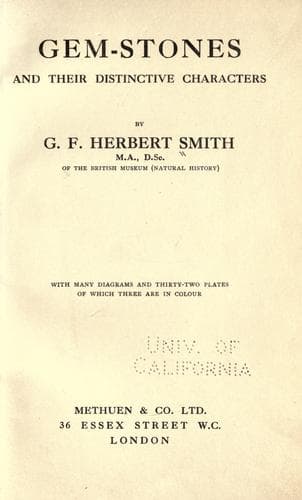
Gem-Stones and Their Distinctive CharactersSmith, George Frederick Herbert
Science
Gem-Stones and Their Distinctive Characters
Smith, George Frederick Herbert
Precious stones
Nearly all red stones are grouped under the name ruby, which is derived
from a Latin word, _ruber_, meaning red, or under other names adapted
from it, such as rubellite, rubicelle. It is properly applied to red
corundum; ‘balas’ ruby is spinel, which is associated with the true
ruby at the Burma mines and is similar in appearance to it when cut,
and ‘Cape’ ruby, is, as has been stated above, a garnet from South
Africa. Rubellite is the lovely rose-pink tourmaline, fine examples of
which have recently been discovered in California, and rubicelle is a
less pronouncedly red spinel. Sapphire is by far the oldest and one
of the most interesting of the words used in the language of jewels.
It occurs in Hebrew and Persian, ancient tongues, and means blue.
It was apparently employed for lapis lazuli or similar substance,
but was transferred to the blue corundum upon the discovery of this
splendid stone. Oblivious of the real meaning of the word, jewellers
apply it in a quasi-generic sense to all the varieties of corundum
with the exception of the red ruby, and give vent to such incongruous
expressions as ‘white sapphire,’ ‘yellow sapphire’; it is true such
stones often contain traces of blue colour, but that is not the reason
of the terms. ‘Brazilian’ sapphire is blue tourmaline, a somewhat rare
tint for this species. The curious history of the word topaz will be
found below in the chapter dealing with the species of that name. It
has always denoted a yellow stone, and at the present day is applied
by jewellers indiscriminately to the true topaz and citrine, the
yellow quartz, the former, however, being sometimes distinguished by
the prefix ‘Brazilian.’ ‘Oriental’ topaz is corundum, and ‘occidental’
topaz is a term occasionally employed for the yellow quartz. Emerald,
which means green, was first used for chrysocolla, an opaque greenish
stone (p. 288), but was afterwards applied to the priceless green
variety of beryl, for which it is still retained. ‘Oriental’ emerald
is corundum, ‘Brazilian’ emerald in the eighteenth century was a
common term for the green tourmaline recently introduced to Europe,
and ‘Uralian’ emerald has been tentatively suggested for the green
garnet more usually known as ‘olivine.’ Amethyst is properly the violet
quartz, but with the prefix ‘oriental’ it is also applied to violet
corundum, though some jewellers use it for the brilliant quartz, with
purple and white sectors, from Siberia. Almandine, which is derived
from the name of an Eastern mart for precious stones, has come to
signify a stone of columbine-red hue, principally garnet, but with
suitable qualification corundum and spinel also.
The nomenclature of jewellery tends to suggest relations between the
gem-stones for which there is no real foundation, and to obscure
the essential identity, except from the point of view of colour, of
sapphire and ruby, emerald and aquamarine, cairngorm and amethyst.
CHAPTER XIV
Public-domain text, read in full here on John Shaqi.
Reviews
Reviews
No reviews yet
Be the first to share your thoughts on this work.
Elsewhere in the archive
Join the Discussion
Join the discussion
Sign in to leave a comment or review.
Sign InorCreate an account