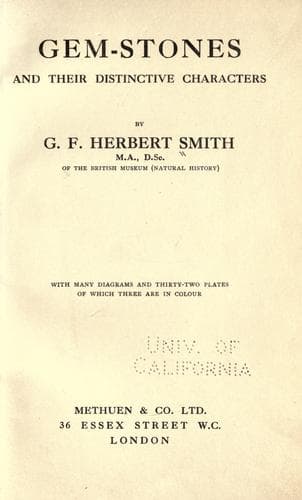
Gem-Stones and Their Distinctive CharactersSmith, George Frederick Herbert
Science
Gem-Stones and Their Distinctive Characters
Smith, George Frederick Herbert
Precious stones
MANUFACTURED STONES
The initial step in the examination of a crystallized substance is
to determine its physical characters and to resolve it by chemical
analysis into its component elements; the final, and by far the
hardest, step is to build it up or synthetically prepare it from its
constituents. Unknown to the world at large, work of the latter kind
has long been going on within the walls of laboratories, and as the
advance in knowledge placed in the hands of experimenters weapons more
and more comparable with those wielded by nature, their efforts have
been increasingly successful. So stupendous, however, are the powers
of nature that the possibility of reproducing, by human agency, the
treasured stones which are extracted from the earth in various parts
of the globe at the cost of infinite toil and labour has always been
derided by those ignorant of what had already been accomplished. Great,
therefore, was the consternation and the turmoil when concrete evidence
that could not be gainsaid showed that man’s restless efforts to
bridle nature to his will were not in vain, and congresses of all the
high-priests of jewellery were hastily convened to ban such unrighteous
products, with what ultimate success remains to be seen.
Crystallization may be caused in four different ways, of which the
second alone has as yet yielded stones large enough to be cut—
1. By the separation of the substance from a saturated solution. In
nature the solvent may not be merely hot water, or water charged with
an acid, but molten rock, and the temperature and the pressure may be
excessively high.
2. By the solidification of the liquefied substance upon cooling. Ice
is a familiar example of this type.
3. By the sublimation of the vapour of the substance, which means the
direct passage from the vapour to the solid state without traversing
the usually intervening liquid state. It is usually the most difficult
of attainment of the four methods; the most familiar instance is snow.
4. By the precipitation of the substance from a solution when set free
by chemical action.
Other things being equal, the simpler the composition the greater is
the ease with which a substance may be expected to be formed; for,
instead of one complex substance, two or more different substances
may evolve, unless the conditions are nicely arranged. Attempts,
for instance, to produce beryl might result instead in a mixture of
chrysoberyl, phenakite, and quartz.
Public-domain text, read in full here on John Shaqi.
Reviews
Reviews
No reviews yet
Be the first to share your thoughts on this work.
Elsewhere in the archive
Join the Discussion
Join the discussion
Sign in to leave a comment or review.
Sign InorCreate an account