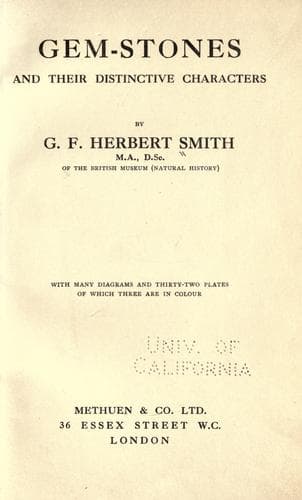
Gem-Stones and Their Distinctive CharactersSmith, George Frederick Herbert
Science
Gem-Stones and Their Distinctive Characters
Smith, George Frederick Herbert
Precious stones
case of old jewellery, covered with foil in the setting, in order to
secure more complete reflection from the interior. The fashioning of
these imitation stones is easy and cheap. Being moulded, they do not
require cutting, and the polishing of the facets thus formed is soon
done on account of the softness of the stones.
A test with a file readily differentiates paste stones from the natural
stones they pretend to be. Being necessarily singly refractive, they
are, of course, lacking in dichroism, and their refractivity seldom
accords even approximately with that of the corresponding natural stone.
In order to meet the test for hardness the doublet was devised. Such
a stone is composed of two parts—the crown consisting of colourless
quartz or other inexpensive real and hard stone, and the base being
made up of coloured glass. When the imitation, say of a sapphire, is
intended to be more exact, the crown is made of a real sapphire, but
one deficient in colour, the requisite tint being obtained from the
paste forming the under part of the doublet. In case the base should
also be tested for hardness the triplet has been devised. In this the
base is made of a real stone also, and the coloured paste is confined
to the girdle section, where it is hidden by the setting. Sapphires and
emeralds of indifferent colour are sometimes slit across the girdle;
the interior surfaces are polished, and colouring matter is introduced
with the cement, generally Canada balsam, which is used to re-unite the
two portions of the stone together. All such imitations may be detected
by placing the stone in oil, when the surfaces separating the portions
of the composite stone will be visible, or the binding cement may be
dissolved by immersing the stone, if unmounted, in boiling water, or in
alcohol or chloroform, when the stone will fall to pieces.
The glass imitations of pearls, which have become very common in recent
years, may, apart from their inferior iridescence, be detected by
their greater hardness, or by the apparent doubling of, say, a spot of
ink placed on the surface, owing to reflection from the inner surface
of the glass shell. They are made of small hollow spheres formed by
blowing. Next to the glass comes a lining of parchment size, and next
the under lining, which is the most important part of the imitation,
consisting of a preparation of fish scales called _Essence d’Orient_,
When the lining is dry, the globe is filled with hot wax to impart the
necessary solidity. In cheap imitations the glass balls are not lined
at all, but merely heated with hydrochloric acid to give an iridescence
to the surface; sometimes they are coated with wax, which can be
scraped off with a knife.
PART II—SECTION A
PRECIOUS STONES
CHAPTER XVI
DIAMOND
Public-domain text, read in full here on John Shaqi.
Reviews
Reviews
No reviews yet
Be the first to share your thoughts on this work.
Elsewhere in the archive
Join the Discussion
Join the discussion
Sign in to leave a comment or review.
Sign InorCreate an account