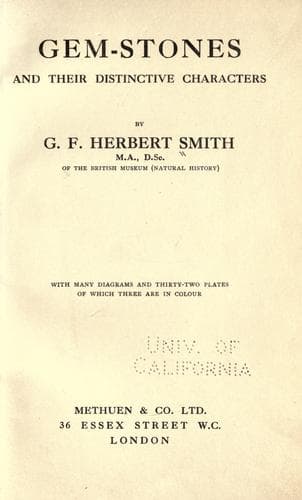
Gem-Stones and Their Distinctive CharactersSmith, George Frederick Herbert
Science
Gem-Stones and Their Distinctive Characters
Smith, George Frederick Herbert
Precious stones
Diamond has held pride of place as chief of precious stones ever
since the discovery of the form of cutting known as the ‘brilliant’
revealed to full perfection its amazing qualities; and justly so,
since it combines in itself extreme hardness, high refraction, large
colour-dispersion, and brilliant lustre. A rough diamond, especially
from river gravels, has often a peculiar greasy appearance, and is
no more attractive to the eye than a piece of washing-soda. It is
therefore easy to understand why the Persians in the thirteenth century
placed the pearl, ruby, emerald, and even peridot before it, and
writers in the Middle Ages frequently esteemed it below emerald and
ruby. The Indian lapidaries, who were the first to realize that diamond
could be ground with its own powder, discovered what a wonderful
difference the removal of the skin makes in the appearance of a stone.
They, however, made no attempt to shape a stone, but merely polished
the natural facets, and only added numerous small facets when they
wished to conceal flaws or other imperfections; indeed, the famous
traveller, Tavernier, from whom most of our knowledge of early mining
in India is obtained, invariably found that a stone covered with many
facets was badly flawed. The full radiant beauty of a diamond comes to
light only when it is cut in brilliant form.
Of all precious stones diamond has the simplest composition; it is
merely crystallized carbon, another form of which is the humble and
useful graphite, commonly known as ‘black-lead.’ Surely nature has
surpassed all her marvellous efforts in producing from the same element
substances with such divergent characters as the hard, brilliant, and
transparent diamond and the soft, dull, and opaque graphite. It is,
however, impossible to draw any sharp dividing line between the two;
soft diamond passes insensibly into hard graphite, and vice versa.
Boart, or bort, as it is sometimes written, is composed of minute
crystals of diamond arranged haphazardly; it possesses no cleavage,
its hardness is greater than that of the crystals, and its colour is
greyish to blackish. Carbon, carbonado, or black diamond, which is
composed of still more minute crystals, is black and opaque, and is
perceptibly harder than the crystals. It passes into graphite, which
varies in hardness, and may have any density between 2·O and 3·O.
Jewellers apply the term boart to crystals or fragments which are of no
service as gems; such pieces are crushed to powder and used for cutting
and polishing purposes.
Public-domain text, read in full here on John Shaqi.
Reviews
Reviews
No reviews yet
Be the first to share your thoughts on this work.
Elsewhere in the archive
Join the Discussion
Join the discussion
Sign in to leave a comment or review.
Sign InorCreate an account