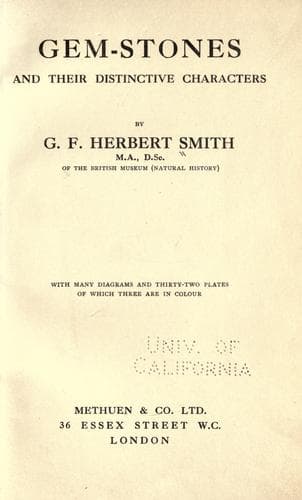
Gem-Stones and Their Distinctive CharactersSmith, George Frederick Herbert
Science
Gem-Stones and Their Distinctive Characters
Smith, George Frederick Herbert
Precious stones
shape or the presence of flaws in the interior were rejected by the
lapidaries, and selling them back again after cleaving them to suitable
forms.
It has already been remarked (p. 79) that the interval in hardness
between diamond and corundum, which comes next to it in Mohs’s scale,
is enormously greater than that between corundum and the softest of
minerals. Diamond can therefore be cut only with the aid of its own
powder, and the cutting of diamond is therefore differentiated from
that of other stones, the precious-stone trade being to a large extent
divided into two distinct groups, namely, dealers in diamonds, and
dealers in all other gem-stones.
The name of the species is derived from the popular form, _adiamentem_,
of the Latin _adamantem_, itself the alliterative form of the Greek
ἀδάμας, meaning the unconquerable, in allusion not merely to the
great hardness but also to the mistaken idea already mentioned. Boart
probably comes from the Old-French _bord_ or _bort_, bastard.
At the present day diamonds are usually cut as brilliants, though
the contour of the girdle may be circular, oval, or drop-shaped to
suit the particular purpose for which the stone is required, or to
keep the weight as great as possible. Small stones for bordering a
large coloured stone may also be cut as roses or points. A perfect
brilliant has 58 facets, but small stones may have not more than 44,
and exceptionally large stones may with advantage have many more; for
instance, on the largest stone cut from the Cullinan diamond there are
no fewer than 74 facets.
The description of the properties of diamond would not be complete
without a reference to the other valuable, if utilitarian, purposes
to which it is put. Without its aid much of modern engineering work
and mining operations would be impossible except at the cost of almost
prohibitive expenditure of time and money.
Boring through solid rock has been greatly facilitated by the use of
the diamond drill. For this purpose carbonado or black diamond is more
serviceable than single crystals, and the price of the former has
consequently advanced from a nominal figure up to £3 to £12 a carat.
The actual working part of the drill consists of a cast-steel ring.
The crown of it has a number of small depressions at regular intervals
into which the carbonados are embedded. On revolution of the drill an
annular ring is cut, leaving a solid core which can be drawn to the
surface. For cooling the drill and for washing away the detritus water
is pumped through to the working face. The duration of the carbonados
depends on the nature of the rock and the skill of the operator. The
most troublesome rock is a sandstone or one with sharp differences in
hardness, because the carbonados are liable to be torn out of their
setting. An experienced operator can tell by the feel of the drill the
nature of the rock at the working face, and by varying the pressure can
mitigate the risk of damage to the drill.
Public-domain text, read in full here on John Shaqi.
Reviews
Reviews
No reviews yet
Be the first to share your thoughts on this work.
Elsewhere in the archive
Join the Discussion
Join the discussion
Sign in to leave a comment or review.
Sign InorCreate an account