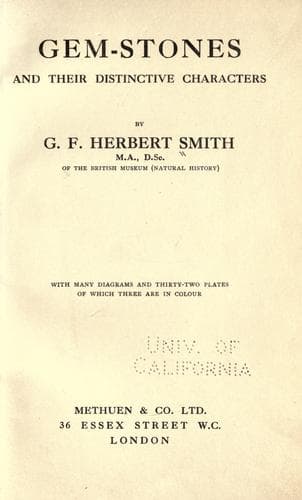
Gem-Stones and Their Distinctive CharactersSmith, George Frederick Herbert
Science
Gem-Stones and Their Distinctive Characters
Smith, George Frederick Herbert
Precious stones
The tenacity of diamond renders it most suitable for wire-drawing. The
tungsten filaments used in many of the latest forms of incandescent
electric lamps are prepared in this manner.
Diamond powder is used for cutting and turning the hardened steel
employed in modern armaments and for other more peaceful purposes.
Although nearly all the gem-stones scratch glass, diamond alone can be
satisfactorily employed to cut it along a definite edge. Any flake at
random will not be suitable, because it will tear the glass and form a
jagged edge. The best results are given by the junction of two edges
which do not meet in too obtuse an angle; two edges of the rhombic
dodecahedron meet the requirements admirably. The stones used by the
glaziers are minute in size, being not much larger than a pin’s head,
and thirty of them on an average go to the carat. They are set in
copper or brass. Some little skill is needed to obtain the best results.
The value of a diamond has always been determined largely by the size
of the stone, the old rule being that the rate per carat should be
multiplied by the square of the weight in carats; thus, if the rate be
£10, the cost of a two-carat stone is four times this sum, or £40, of
a three-carat stone £90, and so on. For a century, from 1750 to 1850,
the rate remained almost constant at £4 for rough, £6 for rose-cut,
and £8 for brilliant-cut diamonds. Since the latter date, owing to
the increase in the supply of gold, the growth of the spending power
of the world, and the gradual falling off in the productiveness of
the Brazilian fields, the rate steadily increased about 10 per cent.
each year, until in 1865 the rate for brilliants was £18. The rise was
checked by the discovery of the South African mines; moreover. since
comparatively large stones are plentiful in these mines, the rule
of the increase in the price of a stone by the square of its weight
no longer holds. The rate for the most perfect stones still remains
high, because such are not so common in the South African mines. The
classification[7] adopted by the syndicate of London diamond merchants
who place upon the market the output of the De Beers group of mines is
as follows:—(_a_) Blue-white, (_b_) white, (_c_) silvery Cape, (_d_)
fine Cape, (_e_) Cape, (_f_) fine bywater, (_g_) bywater, (_h_) fine
light brown, (_i_) light brown, (_j_) brown, (_k_) dark brown. Bywaters
or byes are stones tinged with yellow.
The rate per carat for cut stones in the blue-white and the bywater
groups is:—
BLUE-WHITE. BYWATER.
5-carat stone £40-60 £20-25
1 „ 30-40 10-15
½ „ 20-25 8-12
¼ „ 15-18 6-10
Mêlée 12-15 5-8
Public-domain text, read in full here on John Shaqi.
Reviews
Reviews
No reviews yet
Be the first to share your thoughts on this work.
Elsewhere in the archive
Join the Discussion
Join the discussion
Sign in to leave a comment or review.
Sign InorCreate an account