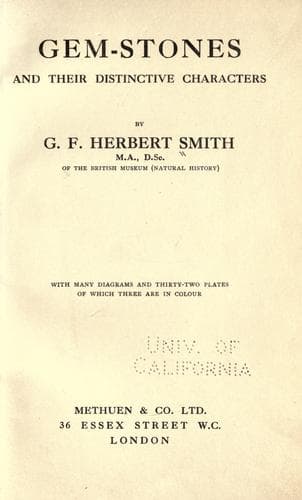
Gem-Stones and Their Distinctive CharactersSmith, George Frederick Herbert
Science
Gem-Stones and Their Distinctive Characters
Smith, George Frederick Herbert
Precious stones
removed all signs of eruptive activity. The principal minerals which
are associated with diamond in the blue ground are magnetite, ilmenite,
chromic pyrope, which is put on the market as a gem under the misnomer
‘Cape-ruby,’ ferriferous enstatite, which also is sometimes cut,
olivine more or less decomposed, zircon, kyanite, and mica.
The evidence produced by an examination of the blue ground and the
walls of the pipes proves that the pipes cannot have been volcanoes
such as Vesuvius. There is no indication whatever of the action of any
excessive temperature, while, on the other hand, there is every sign of
the operation of enormous pressure; the diamonds often contain liquid
drops of carbonic acid. Crookes puts forward the plausible theory that
steam has been the primary agency in propelling the diamond and its
associates up into the channel through which it has carved its way to
freedom, and holds that molten iron has been the solvent for carbon
which has crystallized out as diamond under the enormous pressures
obtaining in remote depths of the earth’s crust. It is pertinent to
note that, by dissolving carbon in molten iron, the eminent chemist,
Moissan, was enabled to manufacture tiny diamond crystals. Water
trickling down from above would be immediately converted into steam at
very high pressure on coming into contact with the molten iron, and, in
its efforts to escape, the steam would drive the iron and its precious
contents, together with the adjacent rocks, upwards to the surface. The
ferriferous nature of the blue ground and the yellow tinge so common
to the diamonds lend confirmation to this theory. The process by which
the carbon was extracted from shales or other carboniferous rocks and
dissolved in iron still awaits elucidation.
Diamonds were found in New South Wales as long ago as 1851 on Turon
River and at Reedy Creek, near Bathurst, about ninety miles (145 km.)
from Sydney, but the find was of little commercial importance. A more
extensive deposit came to light in 1867 farther north at Mudgee. In
1872 diamonds were discovered in the extreme north of the State, at
Bingara near the Queensland border. Another discovery was made in 1884
at Tingha, and still more recently in the tin gravels of Inverell in
the same region. In their freedom from colour and absence of twinning
the New South Wales diamonds resemble the Brazilian stones. The average
size is small, running about five to the carat when cut; the largest
found weighed nearly 6 carats when cut. They are remarkable for their
excessive hardness; they can be cut only with their own dust, ordinary
diamond dust making no impression.
Public-domain text, read in full here on John Shaqi.
Reviews
Reviews
No reviews yet
Be the first to share your thoughts on this work.
Elsewhere in the archive
Join the Discussion
Join the discussion
Sign in to leave a comment or review.
Sign InorCreate an account