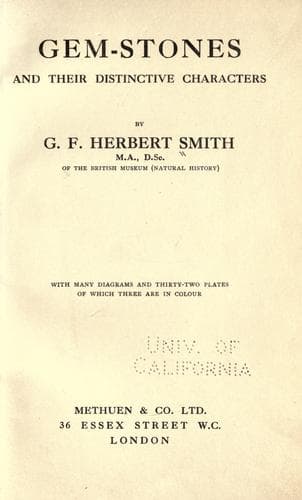
Gem-Stones and Their Distinctive CharactersSmith, George Frederick Herbert
Science
Gem-Stones and Their Distinctive Characters
Smith, George Frederick Herbert
Precious stones
The Borneo diamonds are likewise distinguished by their exceptional
hardness. They mostly occur by the river Landak, near Pontianak on the
west coast of the island. They are found in a layer of rather coarse
gravel, variable, but rarely exceeding a yard (1 m.), in depth, and are
associated with corundum and rutile, together with the precious metals
gold and platinum. Indeed, it is no uncommon sight to see natives
wearing waistcoats ornamented with gold buttons, in each of which a
diamond is set. The diamonds are well crystallized and generally of
pure water; yellowish and canary-yellow stones are also common, but
rose-red, bluish, smoky, and black stones are rare. They seldom exceed
a carat in weight; but stones of 10 carats in weight are found, and
occasionally they attain to 20 carats. In 1850 a diamond weighing 77
carats was discovered. The Rajah of Mattan is said to possess one of
the purest water weighing as much as 367 carats, but no one qualified
to pronounce an opinion regarding its genuineness has ever seen it.
In Rhodesia small diamonds have been found in gravel beds resting on
decomposed granite near the Somabula forest, about 12 miles (19 km.)
west of Gwelo, in association with chrysoberyl in abundance, blue
topaz, kyanite, ruby, sapphire, tourmaline, and garnet.
The occurrence of diamond in German South-West Africa is very peculiar.
Large numbers of small stones are found close to the shore near
Luderitz Bay in a gravelly surface layer, which is nowhere more than a
foot in depth. They are picked by hand by natives and washed in sieves.
In shape they are generally six-faced octahedra or twinned octahedra,
simple octahedra being rare, and in size they run about four or five
to the carat, the largest stone as yet found being only 2 carats in
weight. Their colour is usually yellowish.
Several isolated finds of diamonds have been reported in California
and other parts of the United States, but none have proved of any
importance. The largest stone found weighed 23¾ carats uncut; it was
discovered at Manchester in Virginia.
CHAPTER XVIII
HISTORICAL DIAMONDS
Public-domain text, read in full here on John Shaqi.
Reviews
Reviews
No reviews yet
Be the first to share your thoughts on this work.
Elsewhere in the archive
Join the Discussion
Join the discussion
Sign in to leave a comment or review.
Sign InorCreate an account