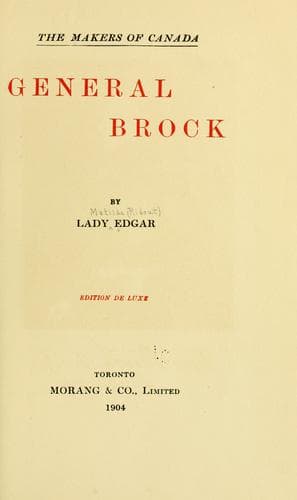
Brock, Isaac, Sir, 1769-1812; Canada -- History -- 1763-1867; United States -- History -- War of 1812
After five days and nights of incessant exertion, the little squadron
reached Amherstburg shortly before midnight on August 13th. There is
a note in General Brock's handwriting which gives this tribute to the
men who accompanied him: "In no instance have I seen troops who would
have endured the fatigue of a long journey in boats during extremely
bad weather, with greater cheerfulness and constancy; and it is but
justice to this little {233} band to add that their conduct
throughout excited my admiration."
[Sidenote: The armistice]
It was well for Canada that no message reached Brock to stop him on
the way, for while he was pressing on, the over-cautious and
vacillating commander-in-chief, possessed with the idea that the
repeal of the orders-in-council would bring a cessation of
hostilities, had sent Colonel Baynes to General Dearborn at Albany,
with a proposition for an armistice.
[1] Sir Thomas Saumarez married, in 1787, Harriet, daughter of
William Brock and Judith de Beauvoir.
[2] In February, 1815, it was estimated that $5,200,000 had been
issued, of which $3,200,000 were bearing interest amounting to
$192,000, of which the province paid $60,000.
{235}
CHAPTER XVIII
BROWNSTOWN AND MAGUAGA
The garrison at Amherstburg consisted of a subaltern detachment of
the Royal Artillery, three hundred men of the 41st, and about the
same number of militia. Captain Chambers, with fifty men of the
41st, had been sent to the Moravian town on the river Thames for the
purpose of collecting the militia and Indians there, and advancing on
the left flank of the enemy. Forty more had been sent to Long Point
to collect the militia in that neighbourhood. Sixty of the 41st had
just arrived with Colonel Procter at Amherstburg. General Hull,
after issuing his futile proclamation, seems to have remained closely
in his quarters at Sandwich, evidently afraid to venture too far from
Fort Detroit. He had not met with the encouragement he expected from
the settlers of Essex and Kent. Although some malcontents had joined
his standard, the majority of the inhabitants had remained firm in
their allegiance to Great Britain. An advance upon Fort Malden
(Amherstburg) had been expected, but three detachments of Americans
on three successive days had been foiled in their attempt to cross
the river Canard, scarcely four miles from that place. On July 22nd
General Hull {236} wrote to Washington: "If Malden were in our
possession, I could inarch the army to Niagara or York in a very
short time." Sir George Prevost on the 27th of the same month had
written to Brock: "The possession of Malden, which I consider means
Amherstburg, appears a favourable object with the government of the
United States. I sincerely hope you will disappoint them."
Public-domain text, read in full here on John Shaqi.
Reviews
Reviews
No reviews yet
Be the first to share your thoughts on this work.
Elsewhere in the archive
Join the Discussion
Join the discussion
Sign in to leave a comment or review.
Sign InorCreate an account