Produced by David Widger
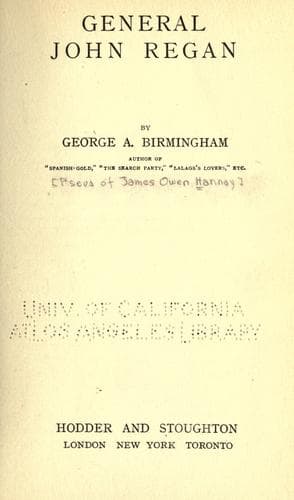
GENERAL JOHN REGAN
By George A. Birmingham
Copyright, 1913 By George H. Doran Company
TO CHARLES H. HAWTREY
who has allowed me to offer this
story to him in memory of times
that were very pleasant to me.
July 1913
Contents
CHAPTER I
CHAPTER II
CHAPTER III
CHAPTER IV
CHAPTER V
CHAPTER VI
CHAPTER VII
CHAPTER VIII
CHAPTER IX
CHAPTER X
CHAPTER XI
CHAPTER XII
CHAPTER XIII
CHAPTER XV
CHAPTER XVI
CHAPTER XVII
CHAPTER XVIII
CHAPTER XIX
CHAPTER XX
CHAPTER I
The Irish police barrack is invariably clean, occasionally picturesque,
but it is never comfortable. The living-room, in which the men spend
their spare time, is furnished with rigid simplicity. There is a table,
sometimes two tables, but they have iron legs. There are benches to
sit on, very narrow, and these also have iron legs. Iron is, of course,
harder than wood. Men who are forced to look at it and rub their legs
against it at meal times are likely to obtain a stern, martial spirit.
Wood, even oak, might in the long run have an enervating effect on their
minds. The Government knows this, and if it were possible to have tables
and benches with iron tops as well as iron legs police barracks in
Ireland would be furnished with them. On the walls of the living-room
are stands for arms. Here are ranged the short carbines with which,
in extreme emergencies, the police shoot at the other inhabitants of
Ireland. The sight of these weapons serves to remind the men that they
form a military force.
Near the carbines hang a few pairs of handcuffs, unobtrusively, because
no one wants to emphasize the fact that the police in Ireland have to
deal with ordinary wrong doers as well as with turbulent mobs. Ornament
of every kind is rigorously excluded from these rooms. It is all very
well to aim at the development of the aesthetic faculty for children by
putting pictures and scraggy geraniums in pots into schoolrooms. No one
wants a policeman to be artistic. But the love of the beautiful breaks
out occasionally, even in policemen who live in barracks. Constable
Moriarty, for instance, had a passion for music. He whistled better
than any man in Ballymoy, and spent much of his leisure in working up
thrilling variations of popular tunes.
Being confined by the call of duty to the living-room of the barrack in
Ballymoy for a whole morning, he had accomplished a series of runs and
trills through which the air of “The Minstrel Boy” seemed to struggle
for expression. His attention was fixed on this composition, and not at
all on the newspaper which lay across his knees.
Public-domain text, read in full here on John Shaqi.
Reviews
Reviews
No reviews yet
Be the first to share your thoughts on this work.
Join the Discussion
Join the discussion
Sign in to leave a comment or review.
Sign InorCreate an account