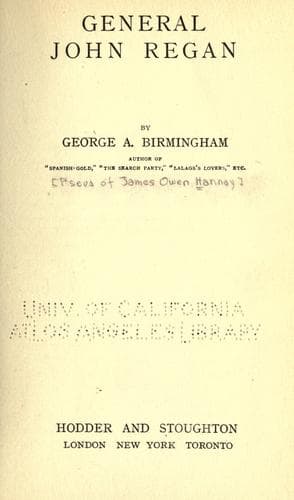
The green posters were distributed far and wide. They adorned every
gatepost and every wall sufficiently smooth to hold them within a circle
of three miles radius around the town. There was some talk beforehand
about the meeting. But on the whole the people displayed very little
curiosity about General John Regan. It was taken for granted that he had
been in some way associated with the cause of Irish Nationality, and one
or two people professed to recollect that he had fought on the side of
the Boers during the South African War. Whoever he was, the people
were inclined to support the movement for erecting a statue to him by
cheering anything which Thady Gallagher said. But they did not intend to
support it in any other way. The Connacht farmer is like the rest of the
human race in his dislike of being asked to subscribe to anything. He is
superior to most other men in his capacity for resisting the pressure of
the subscription list.
On the Saturday before the meeting Gallagher published a long article
on the subject of the General in the Connacht Eagle. It was read, as all
Gallagher’s articles were, with respectful attention. Everybody expected
to find out by reading it who the General was. Everyone felt, as he read
it, or listened to it read aloud, that he was learning all he wanted
to know, and did not discover until he came to talk the matter over
afterwards with his friends that he knew no more when he had read the
article than he did before.
It was not Thady Gallagher but Dr. O’Grady who wrote the article.
Thady made several attempts and then gave up the matter in despair.
Dr. O’Grady, though he was extremely busy at the time, had to do the
writing. It was very well done, and calculated to heat to the boiling
point the enthusiasm of all patriotic people. He began by praising
Thomas Emmet. He passed from him to Daniel O’Connell. He recommended
everyone to read John Mitchell’s “Jail Journal.” He described the great
work done for Ireland by Charles Stewart Parnell. Then he said that
General John Regan was, in his own way, at least the equal, possibly
the superior, of any of the patriots he had named. He wound up the
composition with the statement that it was unnecessary to recapitulate
the great deeds of the General, because every Irishman worthy of the
name knew all about them already.
Public-domain text, read in full here on John Shaqi.
Reviews
Reviews
No reviews yet
Be the first to share your thoughts on this work.
Join the Discussion
Join the discussion
Sign in to leave a comment or review.
Sign InorCreate an account