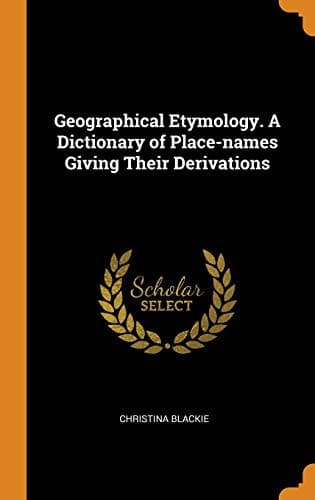
Geographical etymology: a dictionary of place-names giving their derivationsBlackie, Christina
History
Geographical etymology: a dictionary of place-names giving their derivations
Blackie, Christina
Names, Geographical
a country or land; _e.g._ Galatia and Galicia, and anc. _Gallia_ (the
country of the Gauls); Andalusia, for Vandalusia (the country of
the Vandals); Batavia (the good land), _bette_, good; Britania or
Pictavia (probably the land of painted tribes); Catalonia, corrupt.
from _Gothalonia_ (the land of the Goths); Circassia (the land of the
Tcherkes, a tribe); Croatia (the land of the Choriots or mountaineers);
Suabia (of the Suevii); Moravia (the district of the R. Moravia);
Moldavia (of the R. Moldau). It is called by the natives and Turks
Bogdania, from Bogdan, a chieftain who colonised it in the thirteenth
century. Ethiopia (the land of the blacks, or the people with the
sunburnt faces), from Grk. _ops_ (the face), and _aitho_ (to burn);
Phœnicia (the land of palms or the _brown_ land), Grk. _Phœnix_;
Silesia (the land of the Suisli); Bosnia (the district of the R.
Bosna); Russia, named after Rourik, a Scandinavian chief; Siberia, from
_Siber_, the ancient capital of the Tartars; Kaffraria (the country of
the Kaffirs or unbelievers), a name given by the Arabs; Dalmatia (the
country of the Dalmates, who inhabited the city _Dalminium_); Iberia,
the ancient name of Spain, either from the R. Ebro or from a tribe
called the Iberi or Basques; Caledonia, perhaps from _Coille_ (the
wood).
[Sidenote: IACUM,]
an affix used by the Romans, sometimes for _ia_ (a district), and
sometimes the Latinised form of the adjectival termination _ach_--_qu.
v._ p. 5; _e.g._ Juliers, Lat. _Juliacum_ (belonging to Julius Cæsar);
Beauvais, Lat. _Bellovacum_ (belonging to the Bellovaci); Annonay,
Lat. _Annonicum_ (a place for grain, with large magazines of corn);
Bouvignes, in Belgium, Lat. _Boviniacum_ (the place of oxen); Clameny,
Lat. _Clameniacum_ (belonging to Clement, its founder); Joigny, anc.
_Joiniacum_, on the R. Yonne; Annecy, Lat. _Anneacum_ (belonging to
Anecius); Cognac, Lat. _Cogniacum_ (the corner of the water), Fr.
_coin_, Old Fr. _coiny_, Cel. _cuan_.
[Sidenote: IERE,]
an affix in French topography denoting a possession, and generally
affixed to the name of the proprietor; _e.g._ Guilletière (the
property of Guillet); Guzonière (of Guzon).
[Sidenote: ILI (Turc.),]
a district; _e.g._ Ili-Bosnia (the district of the R. Bosna); Rumeli or
Roumelia (the district of the Romans).
[Sidenote: ILLIA (Basque),]
a town; _e.g._ Elloirio, Illora, and Illura (the town on the water,
_ura_); Lorca, anc. _Illurcis_ (the town with fine water); Elibyrge
(the town with the tower), Grk. _pyrgos_; Elché, anc. _Illici_ (the
town on the hill, _ci_); Illiberus (new town, surnamed Elne after the
Empress Helena), in Spain; the isle of Oleron, anc. _Illura_ (the town
on the water).
[Sidenote: IM and IN,]
a contraction for the Ger. _in der_ (in or on the); _e.g._ Imgrund (in
the valley); Imhorst (in the wood); Eimbeck (on the brook); Imruke (on
the ridge).
[Sidenote: ING, INGEN, INGA,]
Public-domain text, read in full here on John Shaqi.
Reviews
Reviews
No reviews yet
Be the first to share your thoughts on this work.
Elsewhere in the archive
Join the Discussion
Join the discussion
Sign in to leave a comment or review.
Sign InorCreate an account