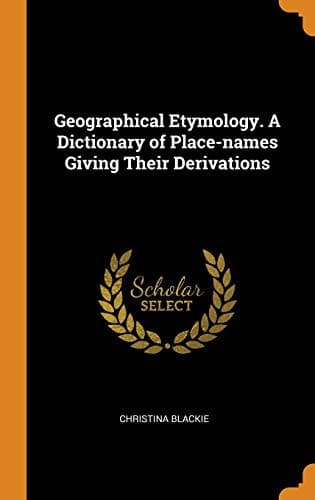
Geographical etymology: a dictionary of place-names giving their derivationsBlackie, Christina
History
Geographical etymology: a dictionary of place-names giving their derivations
Blackie, Christina
Names, Geographical
a flat stone--in topography, found in the forms of _lick_ and _leck_,
cognate with the Lat. _lapis_ and Grk. _lithos_; _e.g._ Lackeen, Licken
(the little stone); Slieve-league (the mountain of the flagstone);
Lickmollasy (St. Molasse’s flagstone); Bel-leek, Irish _Bel-leice_
(the ford of the flagstone), near Ballyshannon; Lackagh (full of
flagstones); Lickfinn (white flagstone); Duleek, anc. _Doimhliag_
(the stone house or church); Auchinleck (the field of the stone), in
Ayrshire; Harlech, in Merioneth; Ar-llech (on the rock, the place being
situated on a craggy eminence); Llananl-lech--_v._ LLAN; Llech-trufin,
probably originally Llech-treffen (the rock of the look-out, or
_twrfine_); Llanml-lech (the church among many stones); Tre-llech
(stone dwelling); Llech-rhyd (the ford of the flat stone); Leck, Lech,
Leckbeck (the stony rivers); Leckfield (the field on the R. Leck);
Leckwith, in Wales, for Lechwedd (a slope).
[Sidenote: LEAMHAN (Gadhelic),]
the elm-tree; _e.g._ the Laune, a river at Killarney, and the Leven,
in Scotland (the elm-tree stream); Lennox or Levenach (the district of
the R. Leven), the ancient name of Dumbartonshire; Lislevane (the fort
of the elm-tree), in Ireland. According to Mr. Skene, the Rivers Leven
in Dumbartonshire and in Fife have given their names to Loch Lomond
and Loch Leven, while in each county there is a corresponding mountain
called Lomond.
[Sidenote: LEARG (Gadhelic),]
the slope of a hill; _e.g._ Largy, in Ireland; Lairg, a parish in
Sutherlandshire; Largs, in Ayrshire, and Largo, in Fife, from this
word; Largan (the little hill-slope); Largynagreana (the sunny
hill-slope); Larganreagh (gray hill-slope), in Ireland.
[Sidenote: LEBEN (Ger.),]
a possession, an inheritance. Forsteman thinks this word is derived
from the Old Ger. _laiban_ (to leave or bequeath), cognate with
the Grk. _leipa_, and not from _leben_ (to live); _e.g._ Leibnitz,
anc. _Dud-leipen_ (the inheritance of Dudo); Ottersleben (of Otho);
Ritzleben (of Richard); Germersleben (of Germer); Osharsleben (of
Ausgar); Sandersleben (of Sander); Hadersleben (of Hada).
[Sidenote: LEGIO (Lat.),]
a Roman legion; _e.g._ Caerleon, on the Usk, anc. _Isca-Legionis_;
Leicester, _Legionis-castra_ (the camp of the legion); Leon, in Spain,
anc. _Legio_, being the station of the seventh Roman legion; Lexdon,
anc. _Legionis-dunum_ (the fort of the legion); Megiddo, in Palestine,
now Ledjun, anc. _Castra-legionis_ (the camp of the legion).
[Sidenote: LEHM (Ger.),
LAAM (A.S.),
LEEM (Dutch),]
clay, mud; _e.g._ the Leam (the muddy river); Leamington (the town on
the R. Leam); Lehmhurst (the clayey wood); Lambourn (muddy brook);
Leemkothen (the mud huts).
[Sidenote: LEITER (Gadhelic),]
Public-domain text, read in full here on John Shaqi.
Reviews
Reviews
No reviews yet
Be the first to share your thoughts on this work.
Elsewhere in the archive
Join the Discussion
Join the discussion
Sign in to leave a comment or review.
Sign InorCreate an account