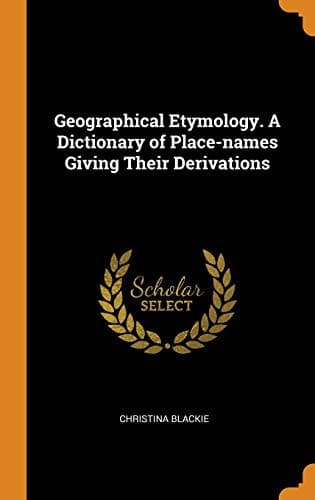
Geographical etymology: a dictionary of place-names giving their derivationsBlackie, Christina
History
Geographical etymology: a dictionary of place-names giving their derivations
Blackie, Christina
Names, Geographical
a head, or a promontory, or hill summit; _e.g._ Pen-carrig (rocky hill
or cape); Pen-brynn (hill summit); Pencoid (of the wood); Penmon (the
promontory of Mona or Anglesea); Pentir (the headland); Pentyrch (the
boar’s head); Pen-y-cwm-gwig (the top of the woody vale), in Wales;
Pen-y-groes (the headland of the cross); Penby-diog (land’s end), in
Wales; Pencelly (the chief grove); Pen-y-gelly (the head of the grove,
_cell_, a grove); Penllech (of the stone or rock); Penhill, Somerset,
and Penlaw, Dumfries (the hill summit); Pendarves (the head of the
oak-field); Penpont (the head of the bridge), in Dumfriesshire; Penn (a
hill), in Stafford; Pencombe (the head of the hollow); Penforfa (of the
moor); Pennant (of the valley); Pen-mynnydd (of the mountain); Penrith,
anc. _Pen-rhyd_ (of the ford); Penicuik (the cuckoo’s hill); Cockpen
(red hill); Pen-maen-maur (the great stone head or hill); Pennigant
(windy hill); Penryn and Penrhyn (the head of the promontory);
Pentraeth (of the strand); Pen-y-craig or Old Radnor (the head of the
rock); Penzance, formerly _Pensans_--it is called the saint’s headland,
from a head of John the Baptist (the town’s arms), but Camden thinks
it might mean the head of the sands; Pain-bœuf or Penn-Ochen (the ox’s
headland); Pendennis (the fort on the headland)--_v._ DINAS. Mount
Pindus and the Grampians, Van in Brecknock, and the Vans in Wales,
embody this root; also the Apennines and the Pennine Alps, Pena and
Penha, in Spain and Portugal are applied to rocks, thus--Penafiel (the
loyal rock), in Spain, and also Cape Penas; Penha-verde (green rock) in
Brazil.
[Sidenote: PFERCH (Ger.),
PEARROC (A.S.),
PARC (Fr.),
PAIRC (Irish).]
In Germany this word signifies an enclosure for cattle--in England
and France, an enclosure for the protection of game or for pleasure;
_e.g._ Parkhurst (the enclosure in the wood); Parkfoot (at the foot
of the park), Co. Stirling; Parkham (park dwelling); Parkmore (great
park or field), in Ireland; Parkatotaun (the field of the burning), Co.
Limerick.
[Sidenote: PFERD (Ger.),]
a horse; _e.g._ Pferdsfeld (the horse’s field); Pfersdorf (the horse’s
village).
[Sidenote: PFORTE (Ger.),
POORT (Dutch),
PORTH (Cym.-Cel.),
PORT (Gadhelic),]
Public-domain text, read in full here on John Shaqi.
Reviews
Reviews
No reviews yet
Be the first to share your thoughts on this work.
Elsewhere in the archive
Join the Discussion
Join the discussion
Sign in to leave a comment or review.
Sign InorCreate an account