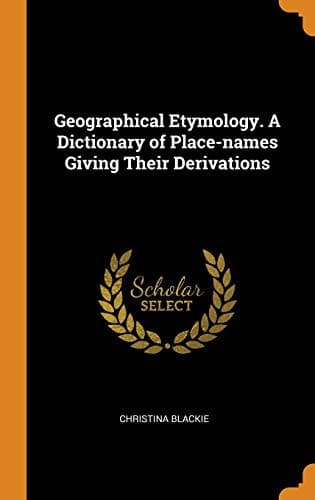
Geographical etymology: a dictionary of place-names giving their derivationsBlackie, Christina
History
Geographical etymology: a dictionary of place-names giving their derivations
Blackie, Christina
Names, Geographical
[Sidenote: RAIN, RAND, RA (Teut. and Scand.),
RHYNN (Cym.-Cel.),
RINN (Irish),
ROINN (Gael.),]
a promontory or peninsula; _e.g._ Rain, a town name in Bavaria
and Styria; Randers, on a promontory in Denmark; Hohenrain (high
promontory); Steenrain (rock headland); Renfrew (the promontory of
the stream, _frew_), anc. _Strathgriff_, on the R. Griff; the Rhinns
(_i.e._ the points), in Galloway; Rhynie, a parish in Aberdeenshire;
Rhind, a parish in Perthshire, with the parish church situated on
a headland jutting into the R. Tay; Rinmore (the great point), in
Devon, Argyle, and Aberdeenshire; Rindon, in Wigton; Tynron, Gael.
_Tigh-an-roinne_ (the house on the point), a parish in Dumfriesshire;
Reay, in Sutherlandshire, and Reay, a station on the Lancaster and
Carlisle Railway, from _Ra_, Norse (a point); Penryn (the head of
the point), in Cornwall. This word, in various forms, such as _rin_,
_reen_, _rine_, _ring_, is of frequent occurrence in Ireland; _e.g._
Ringrone (the seal’s promontory); Rineanna (the promontory of the
marsh, _eanaigh_); Ringville and Ringabella, Irish _Rinn-bhile_ (the
point of the old tree); Ringfad (long point); Ringbane (white point);
Rineen (little point); Ringagonagh (the point of the O’Cooneys);
Rinville, in Galway (the point of Mhil, a Firbolg chieftain); Ringsend,
near Dublin (the end of the point).
[Sidenote: RAJA, RAJ (Sansc.),]
royal; _e.g._ Rajamahal (the royal palace); Rajapoor (royal
city); Rajpootana (the country of the Rajpoots, _i.e._ the king’s
sons--_putra_, a son).
[Sidenote: RAS (Ar.),
ROSH (Heb.),]
a cape; _e.g._ Ras-el-abyad (the white cape); Rasigelbi, corrupt. from
_Rasicalbo_ (the dog’s cape); Rasicarami (the cape of the vineyards);
Ras-el-tafal (chalk cape); Rasicanzar (the swine’s cape); Ras-el-shakah
(the split cape); Ras-el-hamra (red cape); Rascorno (Cape Horn).
[Sidenote: RATH, RAED (Teut.),]
council; _e.g._ Rachstadt or Rastadt (the town of the council or
court of justice); Rathenau (the meadow of the council): Raithby (the
dwelling of the court of justice).
[Sidenote: RATH (Gadhelic),]
a round earthen fort or stronghold, cognate with the Welsh _rhath_, a
mound or hill; _e.g._ Rathmore (the great fort); Ratass or Rathteas
(the south fort); Rattoo or _Rath-tuaith_ (northern fort); Rathbeg
(little fort); Rathduff (black fort); Rathglass (green fort); Rathcoole
(the fort of Cumhal, the father of Finn); Rathcormac (of Cormack);
Rathdrum (of the ridge); Rathdowney, Irish _Rath-tamhnaigh_ (of the
green field); Rathbane (white fort); Rathfryland (Freelan’s fort)--all
in Ireland. Rattray, in Perthshire, where there are the remains of an
old fortress on a hill, and near what is called the Standing Stones,
supposed to have been a Druidical temple; Rathven (hill-fort), in
Banffshire; Rathmorail (the magnificent fort), in Aberdeenshire;
Raphoe, Co. Donegal, abbrev. from _Rathboth_ (the fort of huts).
[Sidenote: REICH, REIKE (Goth.),
RICE (A.S.),
RIGH (Scand.),]
Public-domain text, read in full here on John Shaqi.
Reviews
Reviews
No reviews yet
Be the first to share your thoughts on this work.
Elsewhere in the archive
Join the Discussion
Join the discussion
Sign in to leave a comment or review.
Sign InorCreate an account