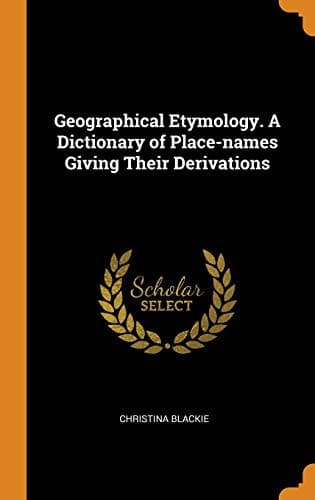
Geographical etymology: a dictionary of place-names giving their derivationsBlackie, Christina
History
Geographical etymology: a dictionary of place-names giving their derivations
Blackie, Christina
Names, Geographical
a snake; _e.g._ Slagenhorst (snake thicket); Schlangenbad (snake bath).
[Sidenote: SCHLEUSE (Ger.),
SLUYS (Dutch),
ECLUSE (Fr.),]
a sluice; _e.g._ Rhinschleuse (the sluice of the Rhine); Sluys, in
Holland; and Slooten, also a town in Holland, on a lake of the same
name (from _sloot_, a ditch); Sluispolder (the reclaimed land at the
sluice); Schlusseburg, in Russia (the fortress at the sluice), built
on an island at the spot where the R. Neva issues from Lake Ladoga;
Helvoetsluis (the sluice on the Haring-vliet, an arm of the R. Maas);
Fort de l’Ecluse (the fortress of the sluice), in France.
[Sidenote: SCHLOSS (Ger.),]
a castle; _e.g._ Marienschloss (the castle of the Virgin Mary);
Heidenschloss (the castle on the heath); Schlossmühle (castle mill);
Schlosshof (the castle court).
[Sidenote: SCHMAL (Ger.),
SMAA (Scand.),]
little; _e.g._ Schmalkalden, anc. _Schmalenaha_ (the town on the small
stream); Smalley, with the same meaning; Smaalehlen (the small fief),
in Norway; Smallburgh (little town); Schmallenberg (little hill);
Smailholm (little hill), a parish in Roxburghshire.
[Sidenote: SCHMEIDE (Ger.),]
a smithy; _e.g._ Nagelschmeide (the nail smithy); Schmeidefeld and
Schmeidsiedel (the field and site of the smithy); Schmeideberg (the
hill of the smithy).
[Sidenote: SCHWAIG (Old Ger.),
SCHWEIG,]
a cattle-shed; _e.g._ Herrnschweige (the count’s cattle-shed);
Brunswick, anc. _Braunsweig_ (Bruno’s shed, or the town of Bruno).
[Sidenote: SCHWAND (Ger.),]
a wood clearing; _e.g._ Schwand or Schwandt, in Bavaria; Schwanden, in
Switzerland; Schwandorf (the village at the wood clearing).
[Sidenote: SCHWARZ (Ger.),]
black; _e.g._ Schwarza, Schwarzach, Schwarzbach, Schwarzwasser (black
stream); Schwarzburg (black fortress); Schwarzberg (black mountain);
Schwarzwald (black wood); Schwarzkreutz (the black cross).
[Sidenote: SCHWERE (Sclav.),]
a wild beast; _e.g._ Schwerin and Schwerinlake, in Mecklenburg; and
Schwersentz, in Posen (places infested by wild beasts).
[Sidenote: SCIR (A.S.),
SCER,]
clear, bright; _e.g._ Sherbourne (the clear stream); but this word is
sometimes used instead of _scyre_, a division or shire, as in Sherwood
(the wood where the shire meetings were held); Sherston (shire boundary
stone); Shardlow and Shardhill (the boundary hill); Sharnford (the
boundary ford); Sharrington (the town of the children of the shire or
division).
[Sidenote: SEANN (Gadhelic),]
old; _e.g._ Shanmullagh (the old summit); Shandrum (the old ridge);
Shangarry (the old garden); Shanbally and Shanvally (the old dwelling);
Shanbo, Shanboe, and Shanbogh (the old hut), in Ireland; also Shankill
(old church), and Shandon, Irish _Seandun_ (old fort). There are
several places in Ireland called Shannon from this word, but it is
uncertain what is the origin of the R. Shannon, whose ancient name
was _Senos_; Sanquhar, Gael. _Seann-Cathair_ (the old fortress), in
Dumfriesshire, named from an old castle near the town.
Public-domain text, read in full here on John Shaqi.
Reviews
Reviews
No reviews yet
Be the first to share your thoughts on this work.
Elsewhere in the archive
Join the Discussion
Join the discussion
Sign in to leave a comment or review.
Sign InorCreate an account