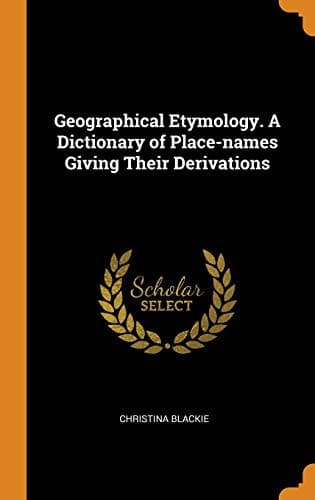
Geographical etymology: a dictionary of place-names giving their derivationsBlackie, Christina
History
Geographical etymology: a dictionary of place-names giving their derivations
Blackie, Christina
Names, Geographical
a fountain or well, from the old word _doboir_, water. Wells and
fountains were held in great veneration by the Celts in heathen times,
and are the subjects of many traditions in Ireland and Scotland. Many
of the early preachers of Christianity established their foundations
near these venerated wells, which were the common resorts of the
people whom they had come to convert. In this way the new religion
became associated in the minds of the converts with their favourite
wells, and obtained the names of the saints, by which they are known
to this day; _e.g._ Tobermory (St. Mary’s well), in the Island of
Mull; Tobar-na-bhan-thighern (the chieftainess’s well), in Badenoch;
Ballintobar (the town of the well), Co. Mayo, now called Tobermore (the
great well), which had a well blessed by St. Patrick; Tibbermore or
Tippermuir (the great well), in Perthshire; Tobar-nam-buadh, in Skye
(the well of virtues); Tipperary, anc. _Tiobrad-Arann_ (the well of the
district of Ara); Tipperkevin (St. Kevin’s well); Tipperstown, anc.
_Baile-an-tobair_ (the town of the well); Tobercurry (the well of the
cauldron); Toberbilly (the well of the old tree); Tobernaclug (the well
of the bells, _clog_). Bells were held sacred by the Irish on account
of a certain bell favoured by St. Patrick. Perhaps the rivers Tiber and
Tiverone, as well as Tivoli, anc. _Tibur_, may come from this root.
[Sidenote: TOFT, TOT (Scand.),]
an enclosure or farm; _e.g._ Lowestoft, Dan. _Luetoft_ (the enclosure
or place of the beacon-fire, which in early times was placed on the
promontory where the town stands); Langtoft (long farm); Monk’s Tofts
(the monk’s farm), and West Tofts, in Norfolk; Ecclestofts (the church
farm buildings), in Berwickshire; Ivetot, anc. _Ivonis-tot_ (the farm
of Ivo and Hautot (high farm), in Normandy; Sassetot (the Saxon’s
farm); Littletot (little farm); Berguetot (birch farm), in Normandy.
[Sidenote: TOM (Gadhelic and Welsh),]
a knoll or mound; _e.g._ Tomintoul (the knoll of the barn), Gael.
_Tom-an-t-sabhail_, Co. Banff; Tomachuraich (the boat-shaped knoll),
Inverness-shire; Tom-ma-Chessaig (St. Kessag’s mound), at Callander;
Tom-na-faire (the knoll of the watch-tower), on Loch Etive; Tomatin
(the knoll of the fire, _teine_); Tomnacroiche (of the gallows);
Tom-da-choill (of the two woods); Tombreck (speckled knoll); Tomgarrow
(rough knoll); Tomnaguie (windy knoll), in Ireland; Tom-bar-lwm (the
mound of the bare hill); Tommen-y-Bala (the mound of Lake Bala, having
been raised as representative of Mount Ararat); Tommen-y-mur (of the
rampart).
[Sidenote: TON (A.S.),
TUN (Scand.),]
Public-domain text, read in full here on John Shaqi.
Reviews
Reviews
No reviews yet
Be the first to share your thoughts on this work.
Elsewhere in the archive
Join the Discussion
Join the discussion
Sign in to leave a comment or review.
Sign InorCreate an account