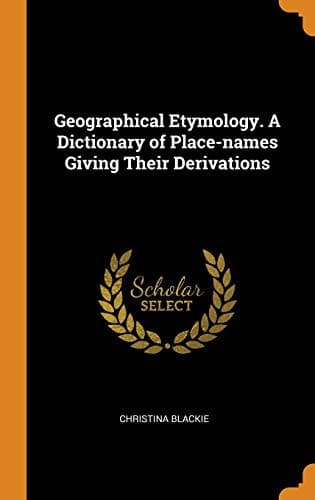
Geographical etymology: a dictionary of place-names giving their derivationsBlackie, Christina
History
Geographical etymology: a dictionary of place-names giving their derivations
Blackie, Christina
Names, Geographical
a river island, or sometimes a plot of ground insulated by marshes
and secured by dykes. It often takes the forms of _werth_ or _wirth_,
cognate with the A.S. _worth_ or _worthing_, _qu. v._; _e.g._
Bischopswerder (the bishop’s island); Elsterwerder, Saarwerder (the
islands in the Rivers Elster and Saar); Donauworth (the island in the
R. Danube); Kirchwerder (church island); Marienwerder (the island or
enclosure dedicated to the Virgin Mary); Falconswaart (the falcon’s
enclosure), in Holland; Poppenwarth (the priest’s enclosure); Werden,
Werder, Wertheim (dwellings near river islands); Worth (the enclosed
place), in Bavaria; Worth-sur-Sauer (the enclosure on the R. Sauer);
Nonnenwerth (the nun’s enclosure); Furstenwerder (the prince’s
island); Verden (near a large island formed by the R. Aller), in
Hanover; Verderbruch (the island bridge); Bolswaard (Bolswine’s
river island), in Holland; Wertingen (a town on an island in the
R. Schmutter); Schönwerder (beautiful island on the R. Unstruth);
Werth-sur-Sauer, in Alsace (on an island formed by the Rivers Sauer
and Soultzbach); Borumeler-Waard (an island near the town of Berumel),
in Holland, formed by the junction of the Rivers Waal and Maas; but
Hoyerswerda, in Silesia, is a corruption of the Wendish name _Worejze_
(the town on the ploughed land).
[Sidenote: WARK, VIRKI (Scand.),]
a fortress; _e.g._ Wark, in Dumfriesshire, Warke Castle, on the
Scottish border; Warkthwaite (the enclosure belonging to the fortress),
in Cumberland; Aldwark (old fortress); Newark, in Nottingham and in
Selkirk (the new fortress); Southwark (the south fortress); Warksburn,
Warkton, Warkworth (places named from their vicinity to Warke Castle),
in Northumberland.
[Sidenote: WASSER, WAZAR (Teut.),
WODA (Sclav.),]
water; _e.g._ Rothwasser (a town on the red river); Schwartzwasser
(black water); Whiteadder (white water), river names; Ullswater
(named from Ulla or Ulf, a Norse chief); Wasserburg, in Bavaria, on
the R. Inn, and Wasserburg on Lake Constance (the town on the water);
Waterloo (the watery marsh); Wasserbillig (the plain by the river);
Zwishenwassern (between the waters, at the confluence of two streams),
in Illyria; Altwasser, Sclav. _Starawoda_ (the old stream), in Moravia.
The ancient name of the R. Odra was _Wodra_ (water).
[Sidenote: WEG (Ger.),
WAAG (Dutch),
WAEG (A.S.),]
a way, a road, cognate with the Lat. _via_; _e.g._ Wegefurt and Wayford
(the way to the ford); Bradenwaag, (broad way); Lichtenweg (the cleared
road); Wegmühle (mill road); Wainfleet (the way by the harbour);
Wakefield (the field by the wayside); Norway, A.S. _Norwaegas_ (the
northern districts or paths); Courbevoie, Lat. _Curba-via_ (the curbed
way), in France.
[Sidenote: WEIDE (Ger.),
WEOD (A.S.),]
pasture; _e.g._ Langenweid (the long pasture); Rathsweide (the
councillor’s pasture); Neuweid (new pasture); Mittweyda (the middle
pasture).
[Sidenote: WEILER (Ger.),]
Public-domain text, read in full here on John Shaqi.
Reviews
Reviews
No reviews yet
Be the first to share your thoughts on this work.
Elsewhere in the archive
Join the Discussion
Join the discussion
Sign in to leave a comment or review.
Sign InorCreate an account