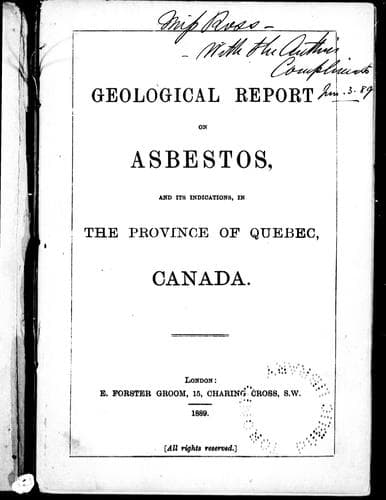
Geological Report on Asbestos and its Indications, in the Province of Quebec, CanadaBoyd, Lucius J.
Science
Geological Report on Asbestos and its Indications, in the Province of Quebec, Canada
Boyd, Lucius J.
Asbestos -- Québec (Province)
In its more limited sense the term "metamorphic" is confined to those
changes of rock which are produced directly or indirectly by agencies
seated in the interior of the earth. In many cases the mode of change
may be explained by our physical or chemical theories, and may be viewed
as the effects of temperature or of electro-chemical actions adjoining
rocks or connecting communications with the interior of the earth, also
distinctly point out the seat from which this change proceeds. In many
other cases the metamorphic process itself remains a mystery, and from
the nature of the products alone do we conclude that such a metamorphic
action has taken place.
Serpentine is generally believed to have been originally deposited as a
sediment, and to have acquired its present compact crystalline character
through the subsequent action of various chemical, or mechanical,
agencies. It is known to be a _hydrated silicate of magnesia_ with about
equal parts of silica and magnesia, and contains 12 per cent. of water
with varying proportions of iron, chromium manganese, alumina and lime,
has a specific gravity of 2.7, and weighs about 169 lbs. to the cubic
foot. It is found both in a soft and very compact state, of a waxy
lustre, with many different shades of beautiful green which give it a
mottled appearance like a serpent, hence the origin of its name
"serpentine," or ophite. It is called "ranocchia" by the Italians, from
the appearance it bears to the "frog," and, on account of its
susceptibility to a high polish, is greatly valued as a marble for
interior ornamental purposes, more than exterior, as it weathers
rapidly. In Galway, Ireland, it is found in large quantities, and called
"serpentinous marble," or "ophi-calcite." It is also to be found in
other parts of the world, as in the Pyrenees, Alps of Dauphing, Mount
St. Gothard, Italy, Sweden, Ural Mountains, Silesia, New South Wales,
Savoy, Corsica, Cornwall, Scotland, and other places too numerous to
mention; but in Canada the finest and most crystalline serpentine is to
be found forming great belts of over 100 miles long and several thousand
feet in breadth. There it associates with the dioretic, or volcanic,
rocks, and is, according to Dr. Ells, without any doubt, "An alteration
product of a dioretic rock rich in olivine." It is sometimes very
difficult to distinguish the mineral constituents in many of the
metamorphic rocks, but diorite is always considered to be composed
chiefly of felspar and hornblende, which composition enters largely into
the serpentines. Actinolite, tremolite, &c., and many other minerals,
are sometimes found associating with it.
Public-domain text, read in full here on John Shaqi.
Reviews
Reviews
No reviews yet
Be the first to share your thoughts on this work.
Join the Discussion
Join the discussion
Sign in to leave a comment or review.
Sign InorCreate an account