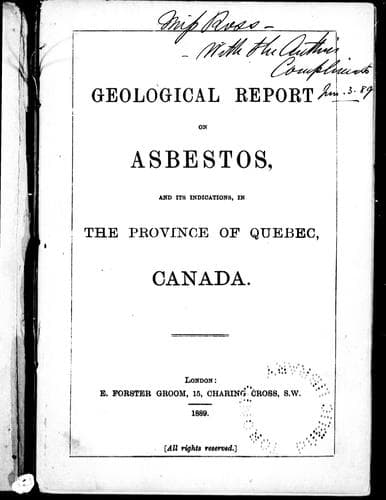
Geological Report on Asbestos and its Indications, in the Province of Quebec, CanadaBoyd, Lucius J.
Science
Geological Report on Asbestos and its Indications, in the Province of Quebec, Canada
Boyd, Lucius J.
Asbestos -- Québec (Province)
As regards the indications of Asbestos, it is a general recognised fact,
and one that may be depended on, that not alone in Canada, but indeed
all other places where Asbestos-bearing serpentine is found, the
existence of Asbestos, or "Amianthus," is noticed when the serpentine is
exposed, and presents a rusted, sometimes greyish and broken appearance,
due to decomposition or weathering, or covered with a thin layer of
soil. Small veins of Asbestos are to be seen forming a network on the
surface of the rock. If closely examined there may be noticed the
indications of a fault which, in the eastern townships of Quebec, has
generally a direction of N. 40° E., this fault appearing in all openings
where a good show of mineral is to be seen, presenting a wall either in
a vertical position or at an angle, which is preferred to be not greater
than 30°. From this wall, at a varying distance of from 5 to 20 feet,
will be found another, sometimes parallel to, or at an opposite angle;
in this latter case, if these walls be worked down, they will be found
to either meet, forming a trough-like appearance, or to change their
course in a downward direction, leaving only a few feet from each other
at the narrowest point, and then diverge to an unlimited depth. In this
case their faces will have a slicken appearance, smeared over with thin
layers of imperfect Asbestos, or crysotile, now and then compact,
fibrous hornblende, up to 24 inches in length, of various colours, and
rich deposits of olivine, in rare cases small quantities of "ground
ivory" with many other admixtures.
The condition of the serpentine within these walls is greatly distorted,
containing many small veins of Asbestos varying from mere threads to 2
and 3 inches in thickness, and sometimes deposits of grains of magnetic
iron or magnetite with traces of chromic iron, which in some localities
break the continuity of the fibre, veins of rich white crystalline
matter (perhaps calcareous) with large deposits of "soapstone," or
steatite, associated with "serpentite." Such contorted out-crops are
indications of rich veins of Asbestos, which will be found to both
increase in quantity and quality the deeper they are worked. And in the
case where the walls are parallel and the filling matter in the same
contorted condition, it is inevitable, in order to obtain a good fibre,
considerable depth should be reached.
The serpentine, which constitute these walls, will also be found to
proportionally become more compact, and less associated with impurities,
and contain the finest quality and lustre of fibre.
Public-domain text, read in full here on John Shaqi.
Reviews
Reviews
No reviews yet
Be the first to share your thoughts on this work.
Join the Discussion
Join the discussion
Sign in to leave a comment or review.
Sign InorCreate an account