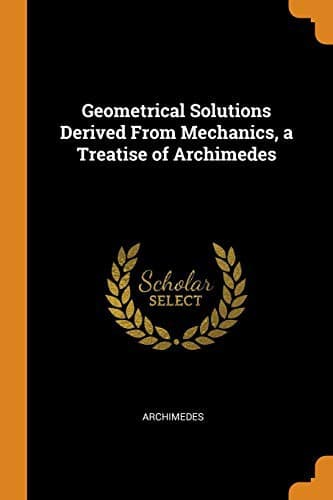
Geometrical Solutions Derived from Mechanics; a Treatise of ArchimedesArchimedes
History
Geometrical Solutions Derived from Mechanics; a Treatise of Archimedes
Archimedes
Geometry -- Early works to 1800
After I had thus perceived that a sphere is four times as large as the
cone whose base is the largest circle of the sphere and whose altitude
is equal to its radius, it occurred to me that the surface of a sphere
is four times as great as its largest circle, in which I proceeded
from the idea that just as a circle is equal to a triangle whose base
is the periphery of the circle and whose altitude is equal to its
radius, so a sphere is equal to a cone whose base is the same as the
surface of the sphere and whose altitude is equal to the radius of the
sphere.
\section*{Proposition III}
By this method it may also be seen that a cylinder whose base is equal
to the largest circle of a spheroid and whose altitude is equal to the
axis of the spheroid, is one and one half times as large as the
spheroid, and when this is recognized it becomes clear that if a
spheroid is cut through its center by a plane perpendicular to its
axis, one-half of the spheroid is twice as great as the cone whose
base is that of the segment and its axis the same.
For let a spheroid be cut by a plane through its axis and let there be
in its surface an ellipse $\alpha\beta\gamma\delta$ [Fig.~3] whose
diameters are $\alpha\gamma$ and $\beta\delta$ and whose center is
$\kappa$ and let there be a circle in the spheroid on the diameter
$\beta\delta$ perpendicular to $\alpha\gamma$; then imagine a cone
whose base is the same circle but whose vertex is at $\alpha$, and
producing its surface, let the cone be cut by a plane through $\gamma$
parallel to the base; the intersection will be a circle perpendicular
to $\alpha\gamma$ with $\epsilon\zeta$ as its diameter. Now imagine a
cylinder whose base is the same circle with the diameter
$\epsilon\zeta$ and whose axis is $\alpha\gamma$; let $\gamma\alpha$
be produced so that $\alpha\theta = \gamma\alpha$; think of
$\theta\gamma$ as a scale-beam with its center at $\alpha$ and in the
parallelogram $\lambda\theta$ draw a straight line $\mu\nu \|
\epsilon\zeta$, and on $\mu\nu$ construct a plane perpendicular to
$\alpha\gamma$; this will intersect the cylinder in a circle whose
diameter is $\mu\nu$, the spheroid in a circle whose diameter is $\xi
o$ and the cone in a circle whose diameter is $\pi\rho$. Because
$\gamma\alpha : \alpha\sigma = \epsilon\alpha : \alpha\pi = \mu\sigma
: \sigma\pi$, and $\gamma\alpha = \alpha\theta$, therefore
$\theta\alpha : \alpha\sigma = \mu\sigma : \sigma\pi$. But $\mu\sigma
: \sigma\pi = \mu\sigma^2 : \mu\sigma \times \sigma\pi$ and $\mu\sigma
\times \sigma\pi = \pi\sigma^2 + \sigma\xi^2$, for $ \alpha\sigma
\times \sigma\gamma : \sigma\xi^2 = \alpha\kappa \times \kappa\gamma :
\kappa\beta^2 = \alpha\kappa^2 : \kappa\beta^2$ (for both ratios are
equal to the ratio between the diameter and the parameter [Apollonius,
\emph{Con.} I, 21]) $ = \alpha\sigma^2 : \sigma\pi^2$ therefore
$\alpha\sigma^2 : \alpha\sigma \times \sigma\gamma = \pi\sigma^2 :
Public-domain text, read in full here on John Shaqi.
Reviews
Reviews
No reviews yet
Be the first to share your thoughts on this work.
Join the Discussion
Join the discussion
Sign in to leave a comment or review.
Sign InorCreate an account