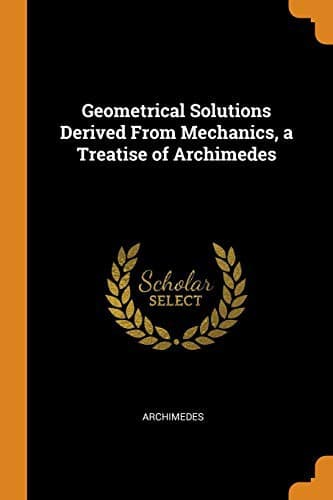
Geometrical Solutions Derived from Mechanics; a Treatise of ArchimedesArchimedes
History
Geometrical Solutions Derived from Mechanics; a Treatise of Archimedes
Archimedes
Geometry -- Early works to 1800
Proposition II states no new fact. Essentially it means that if a
sphere, cylinder, and cone (always circular) have the same radius,
$r$, and the altitude of the cone is $r$ and that of the cylinder
$2r$, then the volumes will be as $4 : 1 : 6$, which is true, since
they are respectively $\frac{4}{3}\pi r^3$, $\frac{1}{3}\pi r^3$, and
$2\pi r^3$. The interesting thing, however, is the method pursued,
the derivation of geometric truths from principles of mechanics. There
is, too, in every sentence, a little suggestion of Cavalieri, an
anticipation by nearly two thousand years of the work of the greatest
immediate precursor of Newton. And the geometric imagination that
Archimedes shows in the last sentence is also noteworthy as one of the
interesting features of this work: ``After I had thus perceived that a
sphere is four times as large as the cone. . . it occurred to me that
the surface of a sphere is four times as great as its largest circle,
in which I proceeded from the idea that just as a circle is equal to a
triangle whose base is the periphery of the circle, and whose altitude
is equal to its radius, so a sphere is equal to a cone whose base is
the same as the surface of the sphere and whose altitude is equal to
the radius of the sphere.'' As a bit of generalization this throws a
good deal of light on the workings of Archimedes's mind.
In proposition III he considers the volume of a spheroid, which he had
already treated more fully in one of his letters to
Dositheos,\footnote{\selectlanguage{greek} Per\`i kwnoeide\~wn kai
sfairoeide\~wn.} and which contains nothing new from a mathematical
standpoint. Indeed it is the method rather than the conclusion that is
interesting in such of the subsequent propositions as relate to
mensuration. Proposition V deals with the center of gravity of a
segment of a conoid, and proposition VI with the center of gravity of
a hemisphere, thus carrying into solid geometry the work of Archimedes
on the equilibrium of planes and on their centers of
gravity.\footnote{\selectlanguage{greek} 'Epip\'edwn \`isorropi\~wn
\^h k\'entra bar\~wn \'epip\'edwn.} The general method is that already
known in the treatise mentioned, and this is followed through
proposition X.
Public-domain text, read in full here on John Shaqi.
Reviews
Reviews
No reviews yet
Be the first to share your thoughts on this work.
Join the Discussion
Join the discussion
Sign in to leave a comment or review.
Sign InorCreate an account