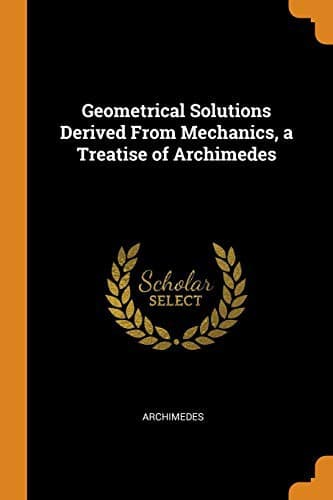
Geometrical Solutions Derived from Mechanics; a Treatise of ArchimedesArchimedes
History
Geometrical Solutions Derived from Mechanics; a Treatise of Archimedes
Archimedes
Geometry -- Early works to 1800
2. If one magnitude is taken away from another magnitude and the
center of gravity of the whole and of the part removed is not the same
point, the center of gravity of the remaining portion may be found by
prolonging the straight line which connects the centers of gravity of
the whole and of the part removed, and setting off upon it another
straight line which bears the same ratio to the straight line between
the aforesaid centers of gravity, as the weight of the magnitude which
has been taken away bears to the weight of the one remaining [\emph{De
plan. aequil.} I, 8].
3. If the centers of gravity of any number of magnitudes lie upon the
same straight line, then will the center of gravity of all the
magnitudes combined lie also upon the same straight line [Cf.
\emph{ibid.} I, 5].
4. The center of gravity of a straight line is the center of that line
[Cf. \emph{ibid.} I, 4].
5. The center of gravity of a triangle is the point in which the
straight lines drawn from the angles of a triangle to the centers of
the opposite sides intersect [\emph{Ibid.} I, 14].
6. The center of gravity of a parallelogram is the point where its
diagonals meet [\emph{Ibid.} I, 10].
7. The center of gravity [of a circle] is the center [of that circle].
8. The center of gravity of a cylinder [is the center of its axis].
9. The center of gravity of a prism is the center of its axis.
10. The center of gravity of a cone so divides its axis that the
section at the vertex is three times as great as the remainder.
11. Moreover together with the exercise here laid down I will make use
of the following proposition:
If any number of magnitudes stand in the same ratio to the same number
of other magnitudes which correspond pair by pair, and if either all
or some of the former magnitudes stand in any ratio whatever to other
magnitudes, and the latter in the same ratio to the corresponding
ones, then the sum of the magnitudes of the first series will bear the
same ratio to the sum of those taken from the third series as the sum
of those of the second series bears to the sum of those taken from the
fourth series [\emph{De Conoid.} I].
\section*{Proposition I}
Let $\alpha\beta\gamma$ [Fig.~1] be the segment of a parabola bounded
by the straight line $\alpha\gamma$ and the parabola
$\alpha\beta\gamma$. Let $\alpha\gamma$ be bisected at $\delta$,
$\delta\beta\epsilon$ being parallel to the diameter, and draw
$\alpha\beta$, and $\beta\gamma$. Then the segrnent
$\alpha\beta\gamma$ will be $\frac{4}{3}$ as great as the triangle
$\alpha\beta\gamma$.
Public-domain text, read in full here on John Shaqi.
Reviews
Reviews
No reviews yet
Be the first to share your thoughts on this work.
Join the Discussion
Join the discussion
Sign in to leave a comment or review.
Sign InorCreate an account