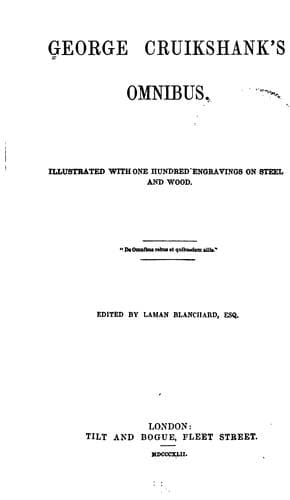
Caricatures and cartoons -- Great Britain; English wit and humor; English wit and humor, Pictorial
This was not clothing the palpable and the familiar with golden
exhalations from the dawn, but it was reducing the glorious and immortal
beauty of Apollo himself to a level with the common-place and the vulgar.
Yet there was something not to be quarrelled with in the association
of ideas to which that object led. It struck me to be the perfection
of the human picturesque. It was a palpable meeting of the Sublime and
the Ridiculous; the world of Intellect and Poetry seemed thrown open to
the meanest capacity; extremes had met; the highest and the lowest had
united in harmonious fellowship. I thought of what the great poet had
himself been, of the parts that he had played, and the wonders he had
wrought, within a stone's-throw of that very spot; and feeling that even
he might have well wished to be there, the pleased spectator of that
lower world, it was impossible not to recognise the fitness of the pipe.
It was the only pipe that would have become the mouth of a poet in that
extraordinary scene; and without it, he himself would have wanted majesty
and the right to be present. I fancied that Sir Walter Raleigh might have
filled it for him. And _what_ a scene was that to preside over and to
contemplate[1]! What a picture of life was there! It was as though Death
were dead! It was _all_ life. In simpler words, I saw, on approaching
the window and peeping between the short red curtains, a swarm of jolly
coal-heavers! Coal-heavers all--save a few of the fairer and softer
sex--the wives of some of them--all enjoying the hour with an intensity
not to be disputed, and in a manner singularly characteristic of the
tastes and propensities of aristocratic and fashionable society;--that is
to say, they were "dancing and taking refreshments." They only did what
"their betters" were doing elsewhere. The living Shakspeare, had he been,
indeed, in the presence, would but have seen a common humanity working
out its objects, and have felt that the _omega_, though the last in the
alphabet, has an astonishing sympathy with the _alpha_ that stands first.
This incident, may I be permitted to say, led me to study the characters
of that particular class of society, and laid the foundation of scenes
afterwards published. The locality and the characters were different,
the spirit was the same. Was I, therefore, what the statement I have
quoted would lead anybody to infer I was, the companion of dustmen,
hodmen, coal-heavers, and scavengers? I leave out the "and so forth" as
superfluous. It would be just as fair to assume that Morland was the
companion of pigs, that Liston was the associate of louts and footmen, or
that Fielding lived in fraternal intimacy with Jonathan Wild.
(4.) "With Mr. Hone" (afterwards designated "the most noted
infidel of his day") "he had long been on terms not only of
intimacy, but of warm friendship."
Public-domain text, read in full here on John Shaqi.
Reviews
Reviews
No reviews yet
Be the first to share your thoughts on this work.
Join the Discussion
Join the discussion
Sign in to leave a comment or review.
Sign InorCreate an account