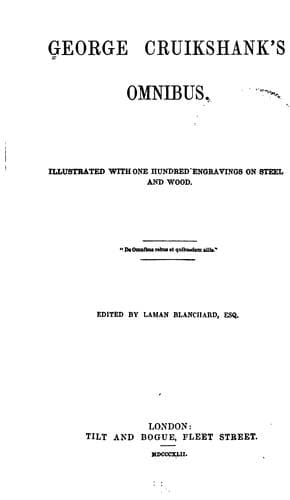
Caricatures and cartoons -- Great Britain; English wit and humor; English wit and humor, Pictorial
I sometimes speculate as to what little boys at school now-a-days talk
about, as to what form the chief subjects of their amusement. It is sadly
to be feared, that the innocent and ingenuous ignorance of my school-days
has been exchanged for a culpable smattering of sophisticated knowledge,
foolishly so called. Oh! who could wish when he calls to mind the days of
his boyhood--at least, who that has a particle of romance, the smallest
dash of sentiment, in his heart, could wish, that the boys of the present
day should be sceptical as to the soothing belief then so prevalent,
that the luscious preparation of sugar and peppermint which they eat,
is really and truly a portion of "Gibraltar Rock;" or that the "brandy
balls," with which they beguile their happy hours, and _clart_ their
fingers' ends, are indeed remnants of the lot of those very "Nelson's
bullets" which spread destruction on "Egypt, Hafnia, Trafalgar."
Some of my readers may perhaps know--I confess my ignorance on this
point--what boys now are. Whether a Doudnean tunic and variegated cap of
divers kinds of cloth warm the possessor of as much solid understanding,
as the honest pepper-and-salt clothes and undoubted beaver hat did in
times gone by. I will, however, endeavour to illustrate what boys were in
the last generation. And first, you shall agree that they excelled as a
body in the inventive faculty. I scarcely need instance Walter Scott--the
following story will establish my point without further aid.
Let us suppose the scene--a moderate-sized room--with eighteen beds or so
in it, and the same number of boys in them, varying in age from eight to
twelve, with every variety of nightcap, from the cosey linen one fitting
"snod" to the head, and tied well under the chin, to the dignified and
manly double cotton with long tuft; these enclosing all the varieties
of hair, known as turnips, carrots, candles, &c. "Now Grant," shouts
the biggest of the lot, "it's your turn to tell a story to-night--don't
be afraid, (he was a new lad,) any thing will do, so fire away, and
I'll thrash the first that interrupts him." The youth thus addressed,
having evidently prepared his story, begins slowly and argumentatively
thus:--"Well, once upon a time there was a mill" (it was considered a
solecism to omit a mill or a castle,) "in a great plain--and a family
lived there--well--and so there were three men, and they went out one
night and walked across the plain--and it grew quite dark;" (here, one
of the youngest lads, frightened at the fearful ideas conjured up by the
last words, gives a faint sigh;) "and so after a bit they began to feel
hungry--and one said Look! there's a light! and they all swore a solemn
oath that they would go to where it was, and get something to eat, or
else kill one another." (Here evident proofs are given that the greater
portion of the audience are deeply interested in the progress of the
tale, for various small sighs are heard, indicative either of sympathy
Public-domain text, read in full here on John Shaqi.
Reviews
Reviews
No reviews yet
Be the first to share your thoughts on this work.
Elsewhere in the archive
Join the Discussion
Join the discussion
Sign in to leave a comment or review.
Sign InorCreate an account