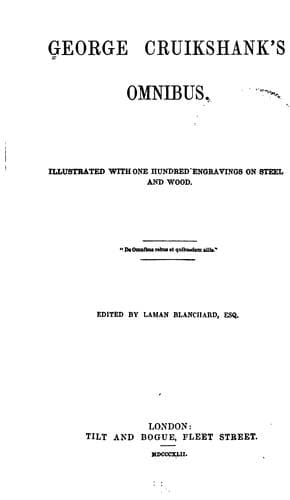
Caricatures and cartoons -- Great Britain; English wit and humor; English wit and humor, Pictorial
with sufferers under the pangs of hunger, or of apprehension lest the
three "jurors," taking the Kilkenny cats as precedents, should eventually
become all of them homicides.) "Well--and so they went to the mill--and
one of them knocked--and then the miller got up, and sharpening a large
knife went to the door and asked who was there?--and the boldest of the
three told him, that they were three travellers, and wanted food and a
lodging. So the miller let them in, and they had a jolly good tuck-out of
tea and buttered toast, and then went to bed.----And so my story's ended."
"Grant--come here!" mildly observes the biggest of the crew. The
youth thus addressed rises cheerfully--advances boldly--and falls
precipitately--levelled by a well-aimed bolster. "Now Grant!" continues
the non-appreciator of a tale worthy for its simplicity of conception
of a Wordsworth--for its pensive dénouement of a Dickens;--"Now Grant,
just pick that up--and won't I lick you to-morrow morning, you precious
fool--that's all."
I cannot lay the flattering unction to my soul, of believing that the
modern dormitory could produce so striking a proof of talent. No sir;
from fountains such as these have risen the immortal strains of a ----
and a ---- (you can fill in the names). In vain will the survivors of
the next generation look for any similar display of talent. But if this
fail to convince you of the decided superiority of the boys of auld
lang syne in one branch of knowledge, give me your attention whilst I
recount an overpowering proof, that in appreciation of real wit and
talent for the ludicrous, they were indeed unrivalled. A new lad had
come, who from having liberally bestowed various "tucks" on almost every
one of his friends in the bed-room was popular on the whole, and received
very cordially by us all. At all our stories connected with the various
"masters," "monitors," "servants," boys that had left, and boys that
remained, (and some of them were by no means amiss,) he seemed rather to
sneer, so that he was voted a dull fellow--a spoon--a sap. When, however,
emboldened by acquaintance with us, he began to talk of the school he had
left, his delight, and even laughter, knew no bounds. "Oh! master was
such a jolly fellow"--he said one day to a select circle of friends--"and
such a funny fellow too he was you don't know--he! he! he! he used to
make us laugh so--he! he! I'll tell you such a funny story of him. There
was a lad called Brown, and master called him Jacky, because his name
was John--he! he! he! Well, one day at dinner, Jacky had only had once
of meat, but he'd two helps of pood;" "Of what?" we all exclaimed. "Oh!
we called _rolly_, _pood_, to distinguish it from _stick-jaw_," was the
explanation given. "So when master said, 'Well, Jacky, will you have any
more pudding?' he! he! he! Jacky said, he! he! 'Please sir,' he! he! ha!
and master said--he! he! '_Jacky's fond of pudding!_' he! he! he! wasn't
that funny?"
Public-domain text, read in full here on John Shaqi.
Reviews
Reviews
No reviews yet
Be the first to share your thoughts on this work.
Elsewhere in the archive
Join the Discussion
Join the discussion
Sign in to leave a comment or review.
Sign InorCreate an account