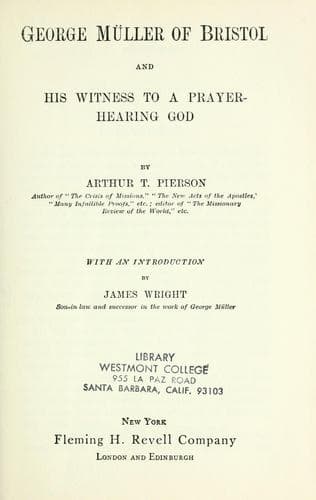
George Müller of Bristol, and His Witness to a Prayer-Hearing GodPierson, Arthur T. (Arthur Tappan)
Religion
George Müller of Bristol, and His Witness to a Prayer-Hearing God
Pierson, Arthur T. (Arthur Tappan)
Müller, George, 1805-1898; Orphanages -- Great Britain; Prayer
A gentleman and some ladies visiting the orphan houses saw the large
number of little ones to be cared for. One of the ladies said to the
matron of the Boys' House: "Of course you cannot carry on these
institutions without a good stock of funds"; and the gentleman added,
"Have you a good stock?" The quiet answer was, "Our funds are deposited
in a bank which cannot break." The reply drew tears from the eyes of the
lady, and a gift of five pounds from the pocket of the gentleman--a
donation most opportune, as there was _not one penny then in hand._
Fellow labourers such as these, who asked nothing for themselves, but
cheerfully looked to the Lord for their own supplies, and willingly
parted with their own money or goods in the hour of need, filled Mr.
Muller's heart with praise to God, and held up his hands, as Aaron and
Hur sustained those of Moses, till the sun of his life went down. During
all the years of his superintendence these were the main human support
of his faith and courage. They met with him in daily prayer, faithfully
kept among themselves the secrets of the Lord's work in the great trials
of faith; and, when the hour of triumph came, they felt it to be both
duty and privilege in the annual report to publish their deliverance, to
make their boast in God, that all men might know His love and
faithfulness and ascribe unto Him glory.
From time to time, in connection with the administration of the work,
various questions arose which have a wider bearing on all departments of
Christian service, for their solution enters into what may be called the
ethics and economics of the Lord's work. At a few of these we may
glance.
As the Lord was dealing with them by the day, it seemed clear that they
were to _live by the day._ No dues [Transcriber's note: unpaid debts]
should be allowed to accumulate, even such as would naturally accrue
from ordinary weekly supplies of bread, milk, etc. From the middle of
September, 1838, it was therefore determined that every article bought
was to be paid for at the time.
Again, rent became due in stated amounts and at stated times. This want
was therefore not unforeseen, and, looked at in one aspect, rent was due
daily or weekly, though collected at longer intervals. The principle
having been laid down that no debt should be incurred, it was considered
as implying that the amount due for rent should be put aside daily, or
at least weekly, even though not then payable. This rule was henceforth
adopted, with this understanding, that money thus laid aside was sacred
to that end, and not to be drawn upon, even temporarily, for any other.
Public-domain text, read in full here on John Shaqi.
Reviews
Reviews
No reviews yet
Be the first to share your thoughts on this work.
Elsewhere in the archive
Join the Discussion
Join the discussion
Sign in to leave a comment or review.
Sign InorCreate an account