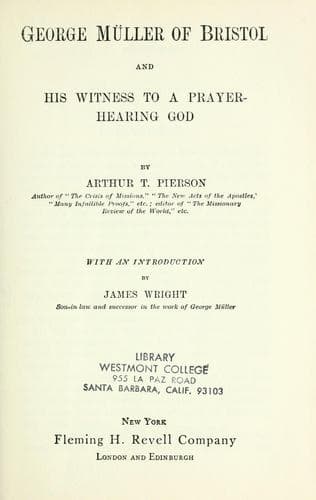
George Müller of Bristol, and His Witness to a Prayer-Hearing GodPierson, Arthur T. (Arthur Tappan)
Religion
George Müller of Bristol, and His Witness to a Prayer-Hearing God
Pierson, Arthur T. (Arthur Tappan)
Müller, George, 1805-1898; Orphanages -- Great Britain; Prayer
4. Asking in accordance with His will. Our motives must be godly: we
must not seek any gift of God to consume it upon our own lusts. (1 John
v. 14; James iv. 3.)
5. Importunity in supplication. There must be waiting on God and waiting
for God, as the husbandman has long patience to wait for the harvest.
(James v. 7; Luke xviii. 1-10.)
The importance of firmly fixing in mind principles such as these cannot
be overstated. The first lays the basis of all prayer, in our oneness
with the great High Priest. The second states a condition of prayer,
found in abandonment of sin. The third reminds us of the need of
honouring God by faith that He is, and is the Rewarder of the diligent
seeker. The fourth reveals the sympathy with God that helps us to ask
what is for our good and His glory. The last teaches us that, having
laid hold of God in prayer, we are to keep hold until His arm is
outstretched in blessing.
Where these conditions do not exist, for God to answer prayer would be
both a dishonour to Himself and a damage to the suppliant. To encourage
those who come to Him in their own name, or in a self-righteous,
self-seeking, and disobedient spirit, would be to set a premium upon
continuance in sin. To answer the requests of the unbelieving would be
to disregard the double insult put upon His word of promise and His oath
of confirmation, by persistent doubt of His truthfulness and distrust of
His faithfulness. Indeed not one condition of prevailing prayer exists
which is not such in the very nature of things. These are not arbitrary
limitations affixed to prayer by a despotic will; they are necessary
alike to God's character and man's good.
All the lessons learned in God's school of prayer made Mr. Muller's
feelings and convictions about this matter more profound and subduing.
He saw the vital relation of prayer to holiness, and perpetually sought
to impress it upon both his hearers and readers; and, remembering that
for the purpose of persuasion the most effective figure of speech is
_repetition,_ he hesitated at no frequency of restatement by which such
truths might find root in the minds and hearts of others.
There has never been a saint, from Abel's day to our own, who has not
been taught the same essential lessons. All prayer which has ever
brought down blessing has prevailed by the same law of success--_the
inward impulse of God's Holy Spirit._ If, therefore, that Spirit's
teachings be disregarded or disobeyed, or His inward movings be
hindered, in just such measure will prayer become formal or be
altogether abandoned. Sin, consciously indulged, or duty, knowingly
neglected, makes supplication an offence to God.
Again, all prayer prevails only in the measure of our real, even if not
conscious, unity with the Lord Jesus Christ as the ground of our
approach, and in the degree of our dependence on Him as the medium of
our access to God.
Public-domain text, read in full here on John Shaqi.
Reviews
Reviews
No reviews yet
Be the first to share your thoughts on this work.
Elsewhere in the archive
Join the Discussion
Join the discussion
Sign in to leave a comment or review.
Sign InorCreate an account