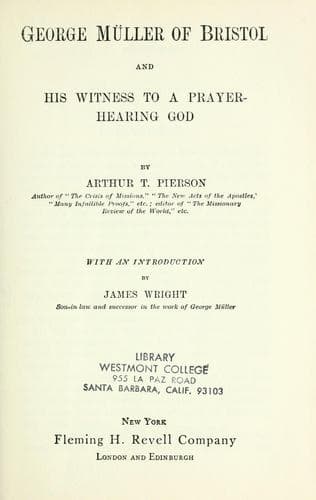
George Müller of Bristol, and His Witness to a Prayer-Hearing GodPierson, Arthur T. (Arthur Tappan)
Religion
George Müller of Bristol, and His Witness to a Prayer-Hearing God
Pierson, Arthur T. (Arthur Tappan)
Müller, George, 1805-1898; Orphanages -- Great Britain; Prayer
The new year 1826 was indeed a _new year_ to this newborn soul. He now
began to read _missionary_ journals, which kindled a new flame in his
heart. He felt a yearning--not very intelligent as yet--to be himself a
messenger to the nations, and frequent praying deepened and confirmed
the impression. As his knowledge of the world-field enlarged, new facts
as to the destitution and the desolation of heathen peoples became as
fuel to feed this flame of the mission spirit.
A carnal attachment, however, for a time almost quenched this fire of
God within. He was drawn to a young woman of like age, a professed
believer, whom he had met at the Saturday-evening meetings; but he had
reason to think that her parents would not give her up to a missionary
life, and he began, half-unconsciously, to weigh in the balance his
yearning for service over against his passion for a fellow creature.
Inclination, alas, outweighed duty. Prayer lost its power and for the
time was almost discontinued, with corresponding decline in joy. His
heart was turned from the foreign field, and in fact from all
self-denying service. Six weeks passed in this state of spiritual
declension, when God took a strange way to reclaim the backslider.
A young brother, Hermann Ball, wealthy, cultured, with every promising
prospect for this world to attract him, made a great self-sacrifice. He
chose Poland as a field, and work among the Jews as his mission,
refusing to stay at home to rest in the soft nest of self-indulgent and
luxurious ease. This choice made on young Muller a deep impression. He
was compelled to contrast with it his own course. For the sake of a
passionate love for a young woman he had given up the work to which he
felt drawn of God, and had become both joyless and prayerless: another
young man, with far more to draw him worldward, had, for the sake of a
self-denying service among despised Polish Jews, resigned all the
pleasures and treasures of the world. Hermann Ball was acting and
choosing as Moses did in the crisis of his history, while he, George
Muller, was acting and choosing more like that profane person Esau, when
for one morsel of meat he bartered his birthright. The result was a new
renunciation--he gave up the girl he loved, and forsook a connection
which had been formed without faith and prayer and had proved a source
of alienation from God.
Public-domain text, read in full here on John Shaqi.
Reviews
Reviews
No reviews yet
Be the first to share your thoughts on this work.
Join the Discussion
Join the discussion
Sign in to leave a comment or review.
Sign InorCreate an account