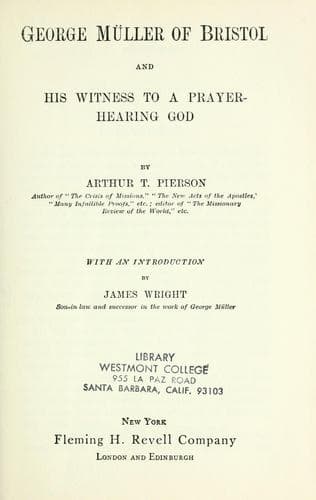
George Müller of Bristol, and His Witness to a Prayer-Hearing GodPierson, Arthur T. (Arthur Tappan)
Religion
George Müller of Bristol, and His Witness to a Prayer-Hearing God
Pierson, Arthur T. (Arthur Tappan)
Müller, George, 1805-1898; Orphanages -- Great Britain; Prayer
In this brief compass no complete outline could be given of the church
life and work so dear to him, and over which he so long watched and
prayed. This church has been and is a missionary church. When on March
1, 1836, Mr. and Mrs. Groves, with ten helpers, left Bristol to carry on
mission work in the East Indies, Mr. Muller felt deeply moved to pray
that the body of disciples to whom he ministered might send out from
their own members labourers for the wide world-field. That prayer was
not forgotten before God, and has already been answered exceeding
abundantly above all he then asked or thought. Since that time some
sixty have gone forth to lands afar to labour in the gospel, and at the
period of Mr. Muller's death there were at work, in various parts of the
world, at least twenty, who are aided by the free-will offerings of
their Bristol brethren.
When, in 1874, Mr. Muller closed the third volume of his Narrative, he
recorded the interesting fact that, of the many nonconformist ministers
of the gospel resident in Bristol when he took up work there more than
forty-two years before, _not one remained,_ all having been removed
elsewhere or having died; and that, of all the Evangelical clergy of the
establishment, only _one_ survived. Yet he himself, with very rare
hindrance through illness, was permitted to preach and labour with
health and vigour both of mind and body; over a thousand believers were
already under his pastoral oversight, meeting in three different
chapels, and over three thousand had been admitted into fellowship.
It was the writer's privilege to hear Mr. Muller preach on the morning
of March 22, 1896, in Bethesda Chapel. He was in his ninety-first year,
but there was a freshness, vigour, and terseness in his preaching that
gave no indication of failing powers; in fact, he had never seemed more
fitted to express and impress the thoughts of God.
His theme was the seventy-seventh psalm, and it afforded him abundant
scope for his favourite subject--prayer. He expounded the psalm verse by
verse, clearly, sympathetically, effectively, and the outline of his
treatment strongly engraved itself on my memory and is here reproduced.
"I cried unto God with my voice." Prayer seeks a voice--to utter itself
in words: the effort to clothe our desires in language gives
definiteness to our desires and keeps the attention on the objects of
prayer.
"In the day of my trouble." The Psalmist was in trouble; some distress
was upon him, perhaps physical as well as mental, and it was an
unceasing burden night and day.
"My soul refused to be comforted." The words, "my sore ran in the
night," may be rendered, "my hand reached out"--that is in prayer. But
unbelief triumphed, and his soul refused all comfort--even the comfort
of God's promises. His trouble overshadowed his faith and shut out the
vision of God.
Public-domain text, read in full here on John Shaqi.
Reviews
Reviews
No reviews yet
Be the first to share your thoughts on this work.
Elsewhere in the archive
Join the Discussion
Join the discussion
Sign in to leave a comment or review.
Sign InorCreate an account