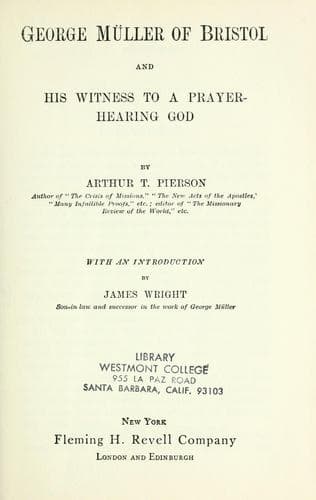
George Müller of Bristol, and His Witness to a Prayer-Hearing GodPierson, Arthur T. (Arthur Tappan)
Religion
George Müller of Bristol, and His Witness to a Prayer-Hearing God
Pierson, Arthur T. (Arthur Tappan)
Müller, George, 1805-1898; Orphanages -- Great Britain; Prayer
"I remembered, or thought of God, and was troubled." Even the thought of
God, instead of bringing peace, brought distress; instead of silencing
his complaint, it increased it, and his spirit was overwhelmed--the sure
sign, again, of unbelief. If in trouble God's promises and the thought
of God bring no relief, they will only become an additional burden.
"Thou holdest mine eyes waking." There was no sleep because there was no
rest or peace. Care makes wakeful. Anxiety is the foe of repose. His
spirit was unbelieving and therefore rebellious. He would not take God
at His word.
"I have considered the days of old." Memory now is at work. He calls to
remembrance former experiences of trouble and of deliverance. He had
often sought God and been heard and helped, and why not now? As he made
diligent search among the records of his experience and recollected all
God's manifest and manifold interpositions, he began to ask whether God
could be fickle and capricious, whether His mercy was exhausted and His
promise withdrawn, whether He had forgotten His covenant of grace, and
shut up His fountains of love.
Thus we follow the Psalmist through six stages of unbelief:
1. The thought of God is a burden instead of a blessing.
2. The complaining spirit increases toward God.
3. His spirit is agitated instead of soothed and calmed.
4. Sleep departs, and anxiety forbids repose of heart.
5. Trouble only deepens and God seems far off.
6. Memory recalls God's mercies, but only to awaken distrust.
At last we reach the _turning-point_ in the psalm: he asks as he reviews
former experiences, WHERE IS THE DIFFERENCE? IS THE CHANGE IN GOD OR IN
ME? "Selah"--the pause marks this turning-point in the argument or
experience.
"And I said, This is _my infirmity."_ In other words, "I HAVE BEEN A
FOOL!" God is faithful. He never casts off. His children are always dear
to Him. His grace is exhaustless and His promise unfailing. Instead of
fixing his eyes on his trouble he now fixes his whole mind on God. He
remembers His work, and meditates upon it; instead of rehearsing his own
trials, he talks of His doings. He gets overwhelmed now, not with the
greatness of his troubles, but the greatness of his Helper. He recalls
His miracles of power and love, and remembers the mystery of His mighty
deeds--His way in the sea, His strange dealings and leadings and their
gracious results--and so faith once more triumphs.
What is the conclusion, the practical lesson?
Unbelief is folly. It charges God foolishly. Man's are the weakness and
failure, but never God's. My faith may be lacking, but not His power.
Memory and meditation, when rightly directed, correct unbelief. God has
shown Himself great. He has always done wonders. He led even an
unbelieving and murmuring people out of Egypt and for forty years
through the wilderness, and His miracles of power and love were
marvelous.
Public-domain text, read in full here on John Shaqi.
Reviews
Reviews
No reviews yet
Be the first to share your thoughts on this work.
Elsewhere in the archive
Join the Discussion
Join the discussion
Sign in to leave a comment or review.
Sign InorCreate an account