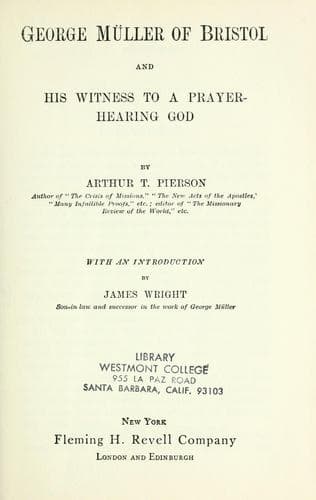
George Müller of Bristol, and His Witness to a Prayer-Hearing GodPierson, Arthur T. (Arthur Tappan)
Religion
George Müller of Bristol, and His Witness to a Prayer-Hearing God
Pierson, Arthur T. (Arthur Tappan)
Müller, George, 1805-1898; Orphanages -- Great Britain; Prayer
In July, 1877, ten pounds from an anonymous source were accompanied by a
letter which conveys another instructive lesson. Years before, the
writer had resolved before God to discontinue a doubtful habit, and send
the cost of his indulgence to the Institution. The vow, made in time of
trouble, was unpaid until God brought the sin to remembrance by a new
trouble, and by a special message from the Word: "Grieve not the Spirit
of God." The victory was then given over the habit, and, the practice
having annually cost about twenty-six shillings, the full amount was
sent to cover the period during which the solemn covenant had not been
kept, with the promise of further gifts in redemption of the same
promise to the Lord. This instance conveys more than one lesson. It
reminds us of the costliness of much of our self-indulgence. Sir Michael
Hicks-Beach, in submitting the Budget for 1897, remarked that what is
annually wasted in the unsmoked remnants of cigars and cigarettes in
Britain is estimated at a million and a quarter pounds--the equivalent
of all that is annually spent on foreign missions by British Christians.
And many forms of self-gratification, in no way contributing to either
health or profit, would, if what they cost were dedicated to the Lord,
make His treasuries overflow. Again, this incident reminds us of the
many vows, made in time of trouble, which have no payment in time of
relief. Many sorrows come back, like clouds that return after the rain,
to remind of broken pledges and unfulfilled obligations, whereby we have
grieved the Holy Spirit of God. "Pay that which thou hast vowed; for God
hath no pleasure in fools." And again we are here taught how a sensitive
and enlightened conscience will make restitution to God as well as to
man; and that past unfaithfulness to a solemn covenant cannot be made
good merely by keeping to its terms _for the future._ No honest man
dishonours a past debt, or compromises with his integrity by simply
beginning anew and paying as he goes. Reformation takes a retrospective
glance and begins in restitution and reparation for all previous wrongs
and unfaithfulness. It is one of the worst evils of our day that even
disciples are so ready to bury the financial and moral debts of their
past life in the grave of a too-easy oblivion.
One donor, formerly living in Tunbridge Wells, followed a principle of
giving, the reverse of the worldly way. As his own family increased,
instead of decreasing his gifts, he gave, for each child given to him of
God, the average cost of maintaining one orphan, until, having seven
children, he was supporting seven orphans.
Public-domain text, read in full here on John Shaqi.
Reviews
Reviews
No reviews yet
Be the first to share your thoughts on this work.
Elsewhere in the archive
Join the Discussion
Join the discussion
Sign in to leave a comment or review.
Sign InorCreate an account