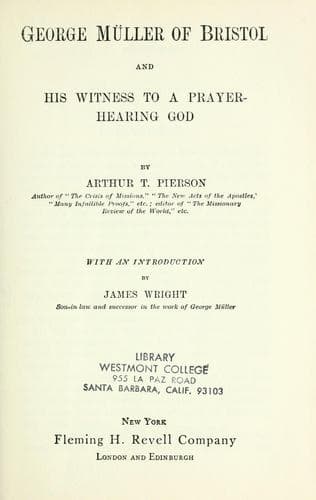
George Müller of Bristol, and His Witness to a Prayer-Hearing GodPierson, Arthur T. (Arthur Tappan)
Religion
George Müller of Bristol, and His Witness to a Prayer-Hearing God
Pierson, Arthur T. (Arthur Tappan)
Müller, George, 1805-1898; Orphanages -- Great Britain; Prayer
An anonymous giver wrote: "It was my idea that when a man had sufficient
for his own wants, he ought then to supply the wants of others, and
consequently I never had sufficient. I now clearly see that God expects
us to give of what we have and not of what we have not, and to leave the
rest to Him. I therefore give in faith and love, knowing that if I first
seek the kingdom of God and His righteousness, all other things will be
added unto me."
Another sends five pounds in fulfillment of a secret promise that, if he
succeeded in passing competitive examination for civil service, he would
make a thank-offering. And he adds that Satan had repeatedly tried to
persuade him that he could not afford it yet, and could send it better
in a little while. Many others have heard the same subtle suggestion
from the same master of wiles and father of lies. Postponement in giving
is usually its practical abandonment, for the habit of procrastination
grows with insensibly rapid development.
Habitual givers generally witnessed to the conscious blessedness of
systematic giving. Many who began by giving a tenth, and perhaps in a
legal spirit, felt constrained, by the growing joy of imparting, to
increase, not the amount only, but the proportion, to a fifth, a fourth,
a third, and even a half of their profits. Some wholly reversed the law
of appropriation with which they began; for at first they gave a tithe
to the Lord's uses, reserving nine tenths, whereas later on they
appropriated nine tenths to the Lord's uses, and reserved for themselves
only a tithe. Those who learn the deep meaning of our Lord's words, "It
is more blessed to give than to receive," find such joy in holding all
things at His disposal that even personal expenditures are subjected to
the scrutiny of conscience and love, lest anything be wasted in
extravagance or careless self-indulgence. Frances Ridley Havergal in her
later years felt herself and all she possessed to be so fully and
joyfully given up to God, that she never went into a shop to spend a
shilling without asking herself whether it would be for God's glory.
Gifts were valued by Mr. Muller only so far as they were the Lord's
money, procured by lawful means and given in the Lord's own way. To the
last his course was therefore most conscientious in the caution with
which he accepted offerings even in times of sorest extremity.
In October, 1842, he felt led to offer aid to a sister who seemed in
great distress and destitution, offering to share with her, if need be,
even his house and purse.
Public-domain text, read in full here on John Shaqi.
Reviews
Reviews
No reviews yet
Be the first to share your thoughts on this work.
Elsewhere in the archive
Join the Discussion
Join the discussion
Sign in to leave a comment or review.
Sign InorCreate an account