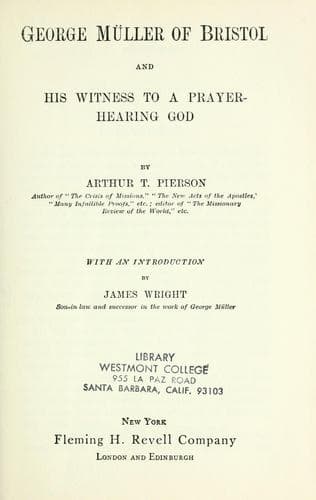
George Müller of Bristol, and His Witness to a Prayer-Hearing GodPierson, Arthur T. (Arthur Tappan)
Religion
George Müller of Bristol, and His Witness to a Prayer-Hearing God
Pierson, Arthur T. (Arthur Tappan)
Müller, George, 1805-1898; Orphanages -- Great Britain; Prayer
"The effectual fervent prayer of a righteous man availeth much," is the
sentence which opens the paragraph. No translation has ever done it
justice. Rotherham renders it: "Much avails a righteous man's
supplication, working inwardly." The Revised Version translates, "avails
much in its working." The difficulty of translating lies not in the
_obscurity_ but in the _fulness_ of the meaning of the original. There
is a Greek middle participle here (Transcriber's note: The Greek word
appears here in parentheses), which may indicate "either the _cause_ or
the _time_ of the effectiveness of the prayer," and may mean, through
its working, or while it is actively working. The idea is that such
prayer has about it supernatural energy. Perhaps the best key to the
meaning of these ten words is to interpret them in the light of the
whole paragraph:
"Elijah was a man subject to like passions as we are, and he prayed
earnestly that it might not rain; and it rained not on the earth by the
space of three years and six months. And he prayed again, and the heaven
gave rain, and the earth brought forth her fruit."
Two things are here plainly put before us: first, that Elijah was but a
man, of like nature with other men and subject to all human frailties
and infirmities; and, secondly, that this man was such a power because
he was a man of prayer: he prayed earnestly; literally "he prayed with
prayer"; prayed habitually and importunately. No man can read Elijah's
short history as given in the word of God, without seeing that he was a
man like ourselves. Under the juniper-tree of doubt and despondency, he
complained of his state and wished he might die. In the cave of a morbid
despair, he had to be met and subdued by the vision of God and by the
still, small voice. He was just like other men. It was not, therefore,
because he was above human follies and frailties, but because he was
subject to them, that he is held up to us as an encouraging example of
power that prevails in prayer. He laid hold of the Almighty Arm because
he was weak, and he kept hold because to lose hold was to let weakness
prevail. Nevertheless, this man, by prayer alone, shut up heaven's
floodgates for three years and a half, and then by the same key unlocked
them. Yes, this man tested the meaning of those wonderful words:
"concerning the work of My hands command ye Me." (Isaiah xlv. 11.) God
put the forces of nature for the time under the sway of this one man's
prayer--one frail, feeble, foolish mortal locked and unlocked the
springs of waters, because he held God's key.
Public-domain text, read in full here on John Shaqi.
Reviews
Reviews
No reviews yet
Be the first to share your thoughts on this work.
Elsewhere in the archive
Join the Discussion
Join the discussion
Sign in to leave a comment or review.
Sign InorCreate an account