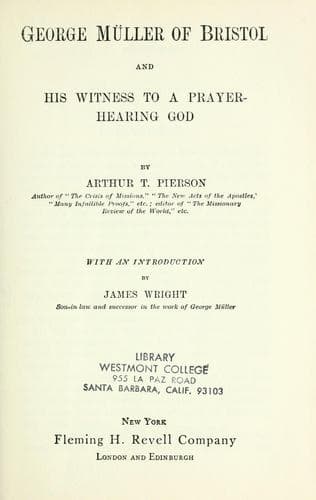
George Müller of Bristol, and His Witness to a Prayer-Hearing GodPierson, Arthur T. (Arthur Tappan)
Religion
George Müller of Bristol, and His Witness to a Prayer-Hearing God
Pierson, Arthur T. (Arthur Tappan)
Müller, George, 1805-1898; Orphanages -- Great Britain; Prayer
George Muller was simply another Elijah. Like him, a man subject to all
human infirmities, he had his fits of despondency and murmuring, of
distrust and waywardness; but he prayed and kept praying. He denied that
he was a miracle-worker, in any sense that implies elevation of
character and endowment above other fellow disciples, as though he were
a specially privileged saint; but in a sense he _was_ a miracle-worker,
if by that is meant that he wrought wonders impossible to the natural
and carnal man. With God all things are possible, and so are they
declared to be to him that believeth. God meant that George Muller,
wherever his work was witnessed or his story is read, should be a
standing rebuke, to the _practical impotence of the average disciple._
While men are asking whether prayer can accomplish similar wonders as of
old, here is a man who answers the question by the indisputable logic of
facts. _Powerlessness always means prayerlessness._ It is not necessary
for us to be sinlessly perfect, or to be raised to a special dignity of
privilege and endowment, in order to wield this wondrous weapon of power
with God; but it _is_ necessary that we be men and women of
prayer--habitual, believing, importunate prayer.
George Muller considered nothing too small to be a subject of prayer,
because nothing is too small to be the subject of God's care. If He
numbers our hairs, and notes a sparrow's fall, and clothes the grass in
the field, nothing about His children is beneath His tender thought. In
every emergency, his one resort was to carry his want to his Father.
When, in 1858, a legacy of five hundred pounds was, after fourteen
months in chancery, still unpaid, the Lord was besought to cause this
money soon to be placed in his hands; and he prayed that legacy out of
the bonds of chancery as prayer, long before, brought Peter out of
prison. The money was paid contrary to all human likelihood, and with
interest at four per cent. When large gifts were proffered, prayer was
offered for grace to know whether to accept or decline, that no money
might be greedily grasped at for its own sake; and he prayed that, if it
could not be accepted without submitting to conditions which were
dishonouring to God, it might be declined so graciously, lovingly,
humbly, and yet firmly, that the manner of its refusal and return might
show that he was acting, not in his own behalf, but as a servant under
the authority of a higher Master.
These are graver matters and might well be carried to God for guidance
and help. But George Muller did not stop here. In the lesser affairs,
even down to the least, he sought and received like aid. His oldest
friend, Robert C. Chapman of Barnstaple, gave the writer the following
simple incident:
Public-domain text, read in full here on John Shaqi.
Reviews
Reviews
No reviews yet
Be the first to share your thoughts on this work.
Elsewhere in the archive
Join the Discussion
Join the discussion
Sign in to leave a comment or review.
Sign InorCreate an account