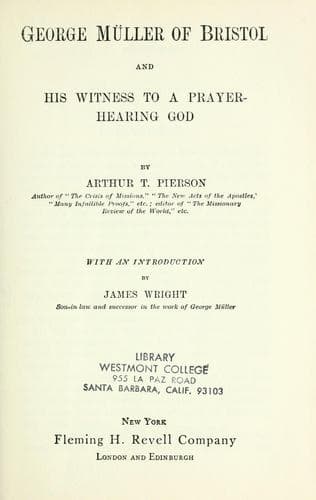
George Müller of Bristol, and His Witness to a Prayer-Hearing GodPierson, Arthur T. (Arthur Tappan)
Religion
George Müller of Bristol, and His Witness to a Prayer-Hearing God
Pierson, Arthur T. (Arthur Tappan)
Müller, George, 1805-1898; Orphanages -- Great Britain; Prayer
In the middle of May, 1829, he was taken ill and felt himself to be past
recovery. Sickness is often attended with strange _self-disclosure._ His
conviction of sin and guilt at his conversion was too superficial and
shallow to leave any after-remembrance. But, as is often true in the
history of God's saints, the sense of guilt, which at first seemed to
have no roots in conscience and scarce an existence, struck deeper into
his being and grew stronger as he knew more of God and grew more like
Him. This common experience of saved souls is susceptible of easy
explanation. Our conceptions of things depend mainly upon two
conditions: first, the clearness of our vision of truth and duty; and
secondly, the standard of measurement and comparison. The more we live
in God and unto God, the more do our eyes become enlightened to see the
enormity and deformity of sin, so that we recognize the hatefulness of
evil more distinctly: and the more clearly do we recognize the
perfection of God's holiness and make it the pattern and model of our
own holy living.
The amateur musician or artist has a false complacency in his own very
imperfect work only so far as his ear or eye or taste is not yet trained
to accurate discrimination; but, as he becomes more accomplished in a
fine art, and more appreciative of it, he recognizes every defect or
blemish of his previous work, until the musical performance seems a
wretched failure and the painting a mere daub. The change, however, is
wholly in the _workman_ and not in the _work:_ both the music and the
painting are in themselves just what they were, but the man is capable
of something so much better, that his standard of comparison is raised
to a higher level, and his capacity for a true judgment is
correspondingly enlarged.
Even so a child of God who, like Elijah, stands before Him as a waiting,
willing, obedient servant, and has both likeness to God and power with
God, may get under the juniper-tree of despondency, cast down with the
sense of unworthiness and ill desert. As godliness increases the sense
of ungodliness becomes more acute, and so feelings never accurately
gauge real assimilation to God. We shall seem worst in our own eyes when
in His we are best, and conversely.
A Mohammedan servant ventured publicly to challenge a preacher who, in
an Indian bazaar, was asserting the universal depravity of the race, by
affirming that he knew at least one woman who was immaculate, absolutely
without fault, and that woman, his own Christian mistress. The preacher
bethought himself to ask in reply whether he had any means of knowing
whether that was her opinion of herself, which caused the Mohammedan to
confess that there lay the mystery: she had been often overheard in
prayer confessing herself the most unworthy of sinners.
Public-domain text, read in full here on John Shaqi.
Reviews
Reviews
No reviews yet
Be the first to share your thoughts on this work.
Join the Discussion
Join the discussion
Sign in to leave a comment or review.
Sign InorCreate an account