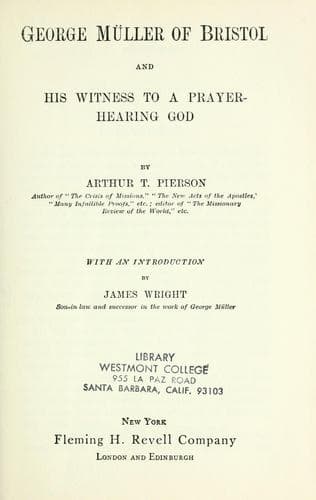
George Müller of Bristol, and His Witness to a Prayer-Hearing GodPierson, Arthur T. (Arthur Tappan)
Religion
George Müller of Bristol, and His Witness to a Prayer-Hearing God
Pierson, Arthur T. (Arthur Tappan)
Müller, George, 1805-1898; Orphanages -- Great Britain; Prayer
While at Teignmouth, early in 1830, preaching by invitation, he was
asked to take the place of the minister who was about to leave, but he
replied that he felt at that time called of God, not to a stationary
charge, but rather to a sort of itinerant evangelism. During this time
he preached at Shaldon for Henry Craik, thus coming into closer contact
with this brother, to whom his heart became knit in bonds of love and
sympathy which grew stronger as the acquaintance became more intimate.
Certain hearers at Teignmouth, and among them some preachers, disliked
his sermons, albeit they were owned of God; and this caused him to
reflect upon the probable causes of this opposition, and whether it was
any indication of his duty. He felt that they doubtless looked for
outward graces of oratory in a preacher, and hence were not attracted to
a foreigner whose speech had no rhetorical charms and who could not even
use English with fluency. But he felt sure of a deeper cause for their
dislike, especially as he was compelled to notice that, the summer
previous, when he himself was less spiritually minded and had less
insight into the truth, the same parties who now opposed him were
pleased with him. His final conclusion was that the Lord meant to work
through him at Teignmouth, but that Satan was acting, as usual, the part
of a hinderer, and stirring up brethren themselves to oppose the truth.
And as, notwithstanding the opposers, the wish that he should minister
at the chapel was expressed so often and by so many, he determined to
remain for a time until he was openly rejected as God's witness, or had
some clear divine leading to another field of labour.
He announced this purpose, at the same time plainly stating that, should
they withhold salary, it would not affect his decision, inasmuch as he
did not preach as a hireling of man, but as the servant of God, and
would willingly commit to Him the provision for his temporal needs. At
the same time, however, he reminded them that it was alike their duty
and privilege to minister in carnal things to those who served them in
things spiritual, and that while he did not desire a gift, he did desire
fruit that might abound to their account.
Public-domain text, read in full here on John Shaqi.
Reviews
Reviews
No reviews yet
Be the first to share your thoughts on this work.
Join the Discussion
Join the discussion
Sign in to leave a comment or review.
Sign InorCreate an account