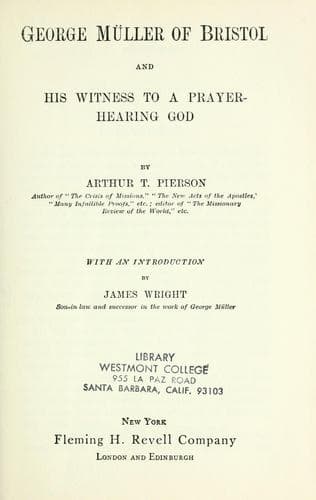
George Müller of Bristol, and His Witness to a Prayer-Hearing God — John Shaqi
George Müller of Bristol, and His Witness to a Prayer-Hearing GodPierson, Arthur T. (Arthur Tappan)
Religion
George Müller of Bristol, and His Witness to a Prayer-Hearing God
Pierson, Arthur T. (Arthur Tappan)
Müller, George, 1805-1898; Orphanages -- Great Britain; Prayer
On his father's removal to Schoenebeck in 1821 he asked to be sent to
the cathedral school at Magdeburg, inwardly hoping thus to break away
from his sinful snares and vicious companions, and, amid new scenes,
find help in self-reform. He was not, therefore, without at least
occasional aspirations after moral improvement; but again he made the
common and fatal mistake of overlooking the Source of all true
betterment. "God was not in all his thoughts." He found that to leave
one place for another was not to leave his sin behind, for he took
himself along.
His father, with a strange fatuity, left him to superintend sundry
alterations in his house at Heimersleben, arranging for him meanwhile to
read classics with the resident clergyman, Rev. Dr. Nagel. Being thus
for a time his own master, temptation opened wide doors before him. He
was allowed to collect dues from his father's debtors, and again he
resorted to fraud, spending large sums of this money and concealing the
fact that it had been paid.
In November, 1821, he went to Magdeburg and to Brunswick, to which
latter place he was drawn by his passion for a young Roman Catholic
girl, whom he had met there soon after confirmation. In this absence
from home he took one step after another in the path of wicked
indulgence. First of all, by lying to his tutor he got his consent to
his going; then came a week of sin at Magdeburg and a wasting of his
father's means at a costly hotel in Brunswick. His money being gone, he
went to the house of an uncle until he was sent away; then, at another
expensive hotel, he ran up bills until, payment being demanded, he had
to leave his best clothes as a security, barely escaping arrest. Then,
at Wolfenbuttel, he tried the same bold scheme again, until, having
nothing for deposit, he ran off, but this time was caught and sent to
jail. This boy of sixteen was already a liar and thief, swindler and
drunkard, accomplished only in crime, a companion of convicted felons
and himself in a felon's cell. This cell, a few days later, a thief
shared: and these two held converse as fellow thieves, relating their
adventures to one another, and young Muller, that he might not be
outdone, invented lying tales of villainy to make himself out the more
famous fellow of the two!
Ten or twelve days passed in this wretched fellowship, until
disagreement led to a sullen silence between them. And so passed away
twenty-four dark days, from December 18, 1821, until the 12th of January
ensuing, during all of which George Muller was shut up in prison and
during part of which he sought as a favour the company of a thief.
His father learned of his disgrace and sent money to meet his hotel dues
and other "costs" and pay for his return home. Yet such was his
persistent wickedness that, going from a convict's cell to confront his
outraged but indulgent parent, he chose as his companion in travel an
avowedly wicked man.
Public-domain text, read in full here on John Shaqi.
Reviews
Reviews
No reviews yet
Be the first to share your thoughts on this work.
Join the Discussion
Join the discussion
Sign in to leave a comment or review.
Sign InorCreate an account