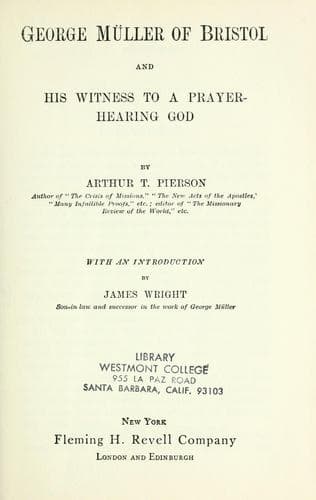
George Müller of Bristol, and His Witness to a Prayer-Hearing GodPierson, Arthur T. (Arthur Tappan)
Religion
George Müller of Bristol, and His Witness to a Prayer-Hearing God
Pierson, Arthur T. (Arthur Tappan)
Müller, George, 1805-1898; Orphanages -- Great Britain; Prayer
We have already seen how the prayer circle had been enlarged. The
founder of the orphan work, at the first, had only God for his partner,
telling Him alone his own wants or the needs of his work. Later on, a
very few, including his own wife, Mr. Craik, and one or two helpers,
were permitted to know the condition of the funds and supplies. Later
still, in the autumn of 1838, he began to feel that he ought more fully
to open the doors of his confidence to his associates in the Lord's
business. Those who shared in the toils should also share in the
prayers, and therefore in the knowledge of the needs which prayer was to
supply; else how could they fully be partakers of the faith, the work,
and the reward? Or, again, how could they feel the full proof of the
presence and power of God in the answers to prayer, know the joy of the
Lord which such answers inspire, or praise Him for the deliverance which
such answers exhibit? It seemed plain that, to the highest glory of God,
they must know the depths of need, the extremities of want out of which
God had lifted them, and then ascribe all honour and praise to His name.
Accordingly Mr. Muller called together all the beloved brothers and
sisters linked with him in the conduct of the work, and fully stated the
case, keeping nothing back. He showed them the distress they were in,
while he bade them be of good courage, assuring them of his own
confidence that help was nigh at hand, and then united them with himself
and the smaller praying circle which had previously existed, in
supplication to Jehovah Jireh.
The step thus taken was of no small importance to all concerned. A
considerable number of praying believers were henceforth added to the
band of intercessors that gave God no rest day nor night. While Mr.
Muller withheld no facts as to the straits to which the work was
reduced, he laid down certain principles which from time to time were
reiterated as unchanging laws for the conduct of the Lord's business.
For example, nothing must be bought, whatever the extremity, for which
there was not money in hand to pay: and yet it must be equally a settled
principle that the children must not be left to lack anything needful;
for better that the work cease, and the orphans be sent away, than that
they be kept in a nominal home where they were really left to suffer
from hunger or nakedness.
Public-domain text, read in full here on John Shaqi.
Reviews
Reviews
No reviews yet
Be the first to share your thoughts on this work.
Elsewhere in the archive
Join the Discussion
Join the discussion
Sign in to leave a comment or review.
Sign InorCreate an account