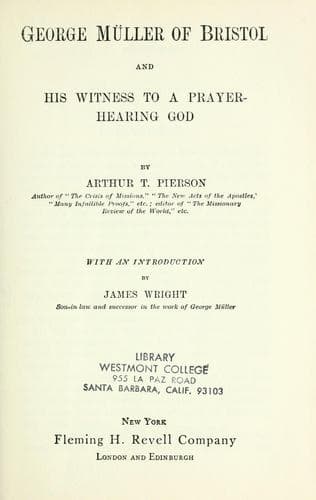
George Müller of Bristol, and His Witness to a Prayer-Hearing GodPierson, Arthur T. (Arthur Tappan)
Religion
George Müller of Bristol, and His Witness to a Prayer-Hearing God
Pierson, Arthur T. (Arthur Tappan)
Müller, George, 1805-1898; Orphanages -- Great Britain; Prayer
Again, nothing was ever to be revealed to outsiders of existing need,
lest it should be construed into an appeal for help; but the only resort
must be to the living God. The helpers were often reminded that the
supreme object of the institutions, founded in Bristol, was to prove
God's faithfulness and the perfect safety of trusting solely to His
promises; jealousy for Him must therefore restrain all tendency to look
to man for help. Moreover, they were earnestly besought to live in such
daily and hourly fellowship with God as that their own unbelief and
disobedience might not risk either their own power in prayer, or the
agreement, needful among them, in order to common supplication. One
discordant note may prevent the harmonious symphony of united prayer,
and so far hinder the acceptableness of such prayer with God.
Thus informed and instructed, these devoted coworkers, with the beloved
founder of the orphan work, met the crisis intelligently. If, when there
were _no funds,_ there must be _no leaning upon man, no debt_ incurred,
and yet _no lack_ allowed, clearly the only resort or resource must be
waiting upon the unseen God; and so, in these straits and in every
succeeding crisis, they went to Him alone. The orphans themselves were
never told of any existing need; in every case their wants were met,
though they knew not how. The barrel of meal might be empty, yet there
was always a handful when needed, and the cruse of oil was never so
exhausted that a few drops were not left to moisten the handful of meal.
Famine and drought never reached the Bristol orphanage: the supplies
might come slowly and only for one day at a time, but somehow, when the
need was urgent and could no longer wait, there was enough--though it
might be barely enough to meet the want.
It should be added here, as completing this part of the Narrative, that,
in August, 1840, this circle of prayer was still further enlarged by
admitting to its intimacies of fellowship and supplication the brethren
and sisters who laboured in the day-schools, the same solemn injunctions
being repeated in their case against any betrayal to outsiders of the
crises that might arise.
Public-domain text, read in full here on John Shaqi.
Reviews
Reviews
No reviews yet
Be the first to share your thoughts on this work.
Elsewhere in the archive
Join the Discussion
Join the discussion
Sign in to leave a comment or review.
Sign InorCreate an account