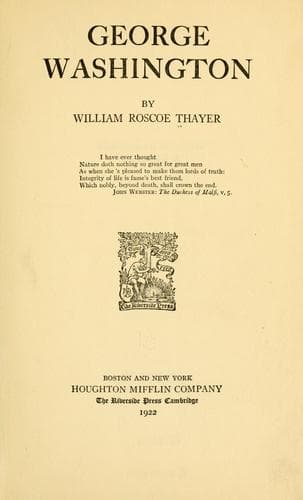
Presidents -- United States -- Biography; Washington, George, 1732-1799
Meanwhile the French Revolution had broken all bounds, and Jefferson, as
the sponsor of the French over here, was kept busy in explaining and
defending the Gallic horrors. The Americans were in a large sense
law-abiding, but in another sense they were lawless. Nevertheless, they
heard with horror of the atrocities of the French Revolutionists--of the
drownings, of the guillotining, of the imprisonment and execution of the
King and Queen--and they had a healthy distrust of the Jacobin Party,
which boasted that these things were natural accompaniments of Liberty
with which they planned to conquer the world. Events in France
inevitably drove that country into war with England. Washington and his
chief advisers believed that the United States ought to remain neutral
as between the two belligerents. But neutrality was difficult. In spite
of their horror at the French Revolution, the memory of our debt to
France during our own Revolution made a very strong bond of sympathy,
whereas our long record of hostility to England during our Colony days,
and since the Declaration of Independence, kept alive a traditional
hatred for Great Britain. While it was easy, therefore, to preach
neutrality, it was very difficult to enforce it. An occurrence which
could not have been foreseen further added to the difficulty of
neutrality.
In the spring of 1793 the French Republic appointed Edmond Charles
Genêt, familiarly called "Citizen Genêt," Minister to the United
States. He was a young man, not more than thirty, of very quick parts,
who had been brought up in the Bureau of Foreign Affairs, had an
exorbitant idea of his own importance, and might be described without
malice as a master of effrontery. The ship which brought him to this
country was driven by adverse winds to Charleston and landed him there
on April 8th. He lost no time in fitting out a privateer against
British mercantile vessels. The fact that by so doing he broke the
American rule of neutrality did not seem to trouble him at all; on the
contrary, he acted as if he were simply doing what the United States
would do if they really did what they wished. As soon as he had made
his arrangements, he proceeded by land up the coast to Philadelphia.
Jefferson was exuberant, and he wrote in exultation to Madison on the
fifth of May, concluding with the phrase, "I wish we may be able
to repress the spirit of the people within the limits of a fair
neutrality." If there be such things as crocodile tears, perhaps there
may also be crocodile wishes, of which this would seem to be one. A
friend of Hamilton's, writing about the same time, speaks in different
terms, as follows:
Public-domain text, read in full here on John Shaqi.
Reviews
Reviews
No reviews yet
Be the first to share your thoughts on this work.
Elsewhere in the archive
Join the Discussion
Join the discussion
Sign in to leave a comment or review.
Sign InorCreate an account