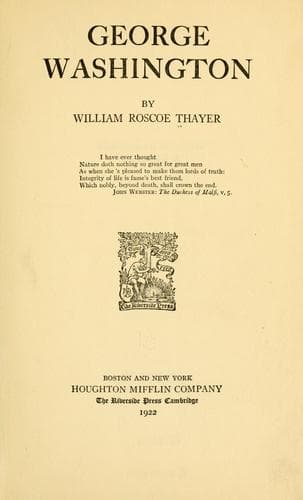
Presidents -- United States -- Biography; Washington, George, 1732-1799
He has a good person, a fine ruddy complexion, quite active, and
seems always in a bustle, more like a busy man than a man of
business. A Frenchman in his manners, he announces himself in all
companies as the Minister of the Republic, etc., talks freely of
his commission, and, like most Europeans, seems to have adopted
mistaken notions of the penetration and knowledge of the people of
the United States. His system, I think, is to laugh us into war if
he can.[1]
[Footnote 1: Irving, V, 151.]
Citizen Genêt did not allow his progress up the coast to be so
rapid that he was deprived of any ovation. The banquets, luncheons,
speech-makings, by which he was welcomed everywhere, had had no
parallel in the country up to that time. They seemed to be too
carefully prepared to be unpremeditated, and probably many of those
who took part in them did not understand that they were cheering for a
cause which they had never espoused. One wonders why he was allowed to
carry on this personal campaign and to show rude unconcern for good
manners, or indeed for any manners except those of a wayward and
headstrong boy. It might be thought that the Secretary of State
abetted him and in his infatuation for France did not check him; but,
so far as I have discovered, no evidence exists that Jefferson was
in collusion with the truculent and impertinent "Citizen." No doubt,
however, the shrewd American politician took satisfaction in observing
the extravagances of his fellow countrymen in paying tribute to the
representative of France. At Philadelphia, for instance, the city
which already was beginning to have a reputation for spinster
propriety which became its boast in the next century, we hear that
"... before Genêt had presented his credentials and been acknowledged
by the President, he was invited to a grand republican dinner, 'at
which,' we are told, 'the company united in singing the Marseillaise
Hymn. A deputation of French sailors presented themselves, and were
received by the guests with the fraternal embrace.' The table was
decorated with the 'tree of liberty,' and a red cap, called the cap
of liberty, was placed on the head of the minister, and from his
travelled in succession from head to head round the table."[1]
[Footnote 1: Jay's _Life_, I, 30.]
But not all the Americans were delirious enthusiasts. Hamilton kept
his head amid the whirling words which, he said, might "do us much
harm and could do France no good." In a letter, which deserves to be
quoted in spite of its length, he states very clearly the opinions of
one of the sanest of Americans. He writes to a friend:
Public-domain text, read in full here on John Shaqi.
Reviews
Reviews
No reviews yet
Be the first to share your thoughts on this work.
Elsewhere in the archive
Join the Discussion
Join the discussion
Sign in to leave a comment or review.
Sign InorCreate an account