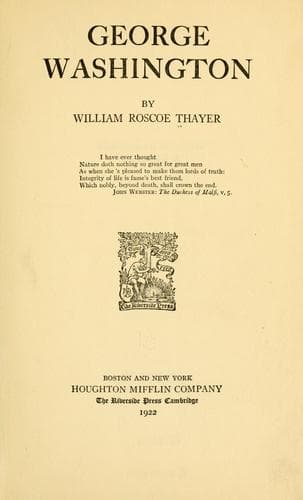
Presidents -- United States -- Biography; Washington, George, 1732-1799
It cannot be without danger and inconvenience to our interests, to
impress on the nations of Europe an idea that we are actuated by
the same spirit which has for some time past fatally misguided the
measures of those who conduct the affairs of France, and sullied
a cause once glorious, and that might have been triumphant. The
cause of France is compared with that of America during its late
revolution. Would to Heaven that the comparison were just! Would
to Heaven we could discern, in the mirror of French affairs, the
same decorum, the same gravity, the same order, the same dignity,
the same solemnity, which distinguished the cause of the American
Revolution! Clouds and darkness would not then rest upon the
issue as they now do. I own I do not like the comparison. When I
contemplate the horrid and systematic massacres of the 2nd and 3rd
of September, when I observe that a Marat and a Robespierre, the
notorious prompters of those bloody scenes, sit triumphantly in
the convention, and take a conspicuous part in its measures--that
an attempt to bring the assassins to justice has been obliged to
be abandoned--when I see an unfortunate prince, whose reign was
a continued demonstration of the goodness and benevolence of his
heart, of his attachment to the people of whom he was the monarch,
who, though educated in the lap of despotism, had given repeated
proofs that he was not the enemy of liberty, brought precipitately
and ignominiously to the block without any substantial proof of
guilt, as yet disclosed--without even an authentic exhibition of
motives, in decent regard to the opinions of mankind; when I find
the doctrine of atheism openly advanced in the convention, and
heard with loud applause; when I see the sword of fanaticism
extended to force a political creed upon citizens who were invited
to submit to the arms of France as the harbingers of liberty; when
I behold the hand of rapacity outstretched to prostrate and ravish
the monuments of religious worship, erected by those citizens and
their ancestors; when I perceive passion, tumult, and violence
usurping those seats, where reason and cool deliberation ought to
preside, I acknowledge that I am glad to believe there is no real
resemblance between what was the cause of America and what is the
cause of France; that the difference is no less great than that
between liberty and licentiousness. I regret whatever has a
tendency to confound them, and I feel anxious, as an American,
that the ebullitions of inconsiderate men among us may not tend to
involve our reputation in the issue.[1]
[Footnote 1: _Hamilton's Works_, 566.]
Public-domain text, read in full here on John Shaqi.
Reviews
Reviews
No reviews yet
Be the first to share your thoughts on this work.
Elsewhere in the archive
Join the Discussion
Join the discussion
Sign in to leave a comment or review.
Sign InorCreate an account