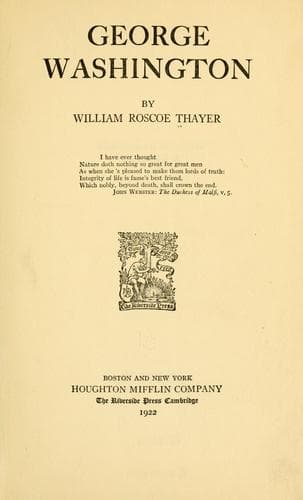
Presidents -- United States -- Biography; Washington, George, 1732-1799
connections between the East and the West strong and open.
In the House of Burgesses Washington was a taciturn member, yet he
seemed to have got a great deal of political knowledge and wisdom so
that his colleagues thought of him as the solid man of the House
and they referred many matters to him as if for final decision. He
followed political affairs in the newspapers. Above all, at Mount
Vernon he heard all sides from the guests who passed his domain and
enjoyed his hospitality. From the moment that the irritation between
Great Britain and the Colonies became bitter he seems to have made up
his mind that the contention of the Colonists was just. After that
he never wavered, but he was not a sudden or a shallow clamorer for
Independence. He believed that the sober second sense of the British
would lead them to perceive that they had made a mistake. When at
length the Colonies had to provide themselves with an army and to
undertake a war, he was the only candidate seriously considered for
General, although John Hancock, who had made his peacock way so
successfully in many walks of life, thought that he alone was
worthy of the position. Who shall describe Washington's life as
Commander-in-Chief of the Colonial forces during the Revolutionary
War? What other commander ever had a task like his? For a few weeks
the troops led by Napoleon--the barefooted and ragged heroes of Lodi
and Arcola and Marengo--were equally destitute, but victory brought
them food and clothes and prosperity. Whereas Washington's men had no
comfort before victory and none after it.
Some of the military critics to-day deny Washington's right to be
ranked among the great military commanders of the world, but the truth
is that he commanded during nearly eight years and won one of the
supreme crucial wars of history against far superior forces. The
General who did that was no understrapper. The man whose courage
diffused itself among the ten thousand starving soldiers at Valley
Forge, and enabled them to endure against the starvation and distress
of a winter, may very well fail to be classified among the Prince
Ruperts and the Marshal Neys of battle, but he ranks first in a
higher class. His Fabian policy, which troubled so many of his
contemporaries, saved the American Revolution. His title as General
is secure. Nor should we forget that it was his scrupulous patriotism
which prevented the cropping out of militarism in this country.
Public-domain text, read in full here on John Shaqi.
Reviews
Reviews
No reviews yet
Be the first to share your thoughts on this work.
Elsewhere in the archive
Join the Discussion
Join the discussion
Sign in to leave a comment or review.
Sign InorCreate an account