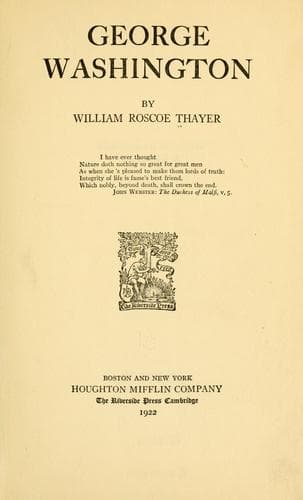
Presidents -- United States -- Biography; Washington, George, 1732-1799
Finally, a country which owed its existence to him chose him to be for
eight years its first President. He saw the planting of the roots of
the chief organs of its government. In every act he looked far forward
into the future. He shunned making or following evil precedents. He
endured the most virulent personal abuse that has ever been poured out
on American public men, preferring that to using the power which his
position gave him, and denaturing the President into a tyrant. Nor
should we fail to honor him for his insistence on dignity and a proper
respect for his office. His enemies sneered at him for that, but
we see plainly how much it meant to this new Nation to have such
qualities exemplified. Had Thomas Jefferson been our first President
in his _sans-culotte_ days, our Government might not have outlasted
the _sans-culottist_ enthusiasts in France. A man is known by his
friends. The chosen friends of Washington were among the best of his
time in America. Hamilton, Henry Knox, Nathanael Greene, John Jay,
John Marshall--these were some.
Although Washington was less learned than many of the men of his time
in political theory and history, he excelled them all in a concrete
application of principles. He had the widest acquaintance among men of
different sorts. He heard all opinions, but never sacrificed his own.
As I have said earlier, he was the most _actual_ statesman of his
time; the people in Virginia came very early to regard him as a man
apart; this was true of the later days when the Government sat in New
York and Philadelphia. If they sought a reason, they usually agreed
that Washington excelled by his character, and if you analyze most
closely you will never get deeper than that. Reserved he was, and not
a loose or glib talker, but he always showed his interest and gave
close attention. After Yorktown, when the United States proclaimed to
the world that they were an independent Republic, Europe recognized
that this was indeed a Republic unlike all those which had preceded it
during antiquity and the Middle Age. Foreigners doubted that it could
exist. They doubted that Democracy could ever govern a nation. They
knew despots, like the Prussian King, Frederic, who walked about the
streets of Berlin and used his walking-stick on the cringing persons
whom he passed on the sidewalk and did not like the looks of. They
remembered the crazy Czar, Peter, and they knew about the insane
tendencies of the British sovereign, George. The world argued from
these and other examples that monarchy was safe; it could not doubt
that the supply of monarchs would never give out; but it had no hope
of a Republic governed by a President. It was George Washington more
than any other agency who made the world change its mind and conclude
that the best President was the best kind of monarch.
Public-domain text, read in full here on John Shaqi.
Reviews
Reviews
No reviews yet
Be the first to share your thoughts on this work.
Elsewhere in the archive
Join the Discussion
Join the discussion
Sign in to leave a comment or review.
Sign InorCreate an account