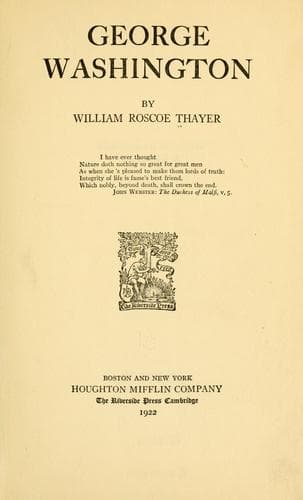
Presidents -- United States -- Biography; Washington, George, 1732-1799
The bridal couple spent two or three months at the White House. The
Custis estates were large and in so much need of oversight that if
Washington had not appeared at this time, a bailiff, or manager, would
have had to be hired for them. Henceforth Washington seems to have
added the care of the White House to that of Mount Vernon, and the two
involved a burden which occupied most of his time, for he had retired
from the army. His fellow citizens, however, had elected him a member
of the House of Burgesses, a position he held for many years; going to
Williamsburg every season to attend the sessions of the Assembly.
On his first entrance to take his seat, Mr. Robinson, the Speaker,
welcomed him in Virginia's name, and praised him for his high
achievements. This so embarrassed the modest young member that he was
unable to reply, upon which Speaker Robinson said, "Sit down, Mr.
Washington, your modesty is equal to your valor, and that surpasses
the power of any language that I possess." In all his life, probably,
Washington never heard praise more genuine or more deserved. He had
just passed his twenty-seventh year. In the House of Burgesses he had
the reputation of being the silent member. He never acquired the art
of a debater. He was neither quick at rebuttal nor at repartee, but
so surely did his character impress itself on every one that when he
spoke the Assembly almost took it for granted that he had said the
final word on the subject under discussion. How careful he was to
observe the scope and effects of parliamentary speaking appears from a
letter which he wrote many years later.
Agriculture has always been a particularly fine training-ground
for statesmen. To persons who do not watch it closely, it may seem
monotonous. In reality, while the sum of the conditions of one year
tally closely with those of another, the daily changes and variations
create a variety which must be constantly watched and provided for. A
sudden freshet and unseasonable access of heat or cold, a scourge of
hail, a drought, a murrain among the cattle, call for ingenuity and
for resourcefulness; and for courage, a higher moral quality. Constant
comradeship with Nature seems to beget placidity and quiet assurance.
From using the great natural forces which bring to pass crops and the
seasons, they seem to work in and through him also. The banker, the
broker, even the merchant, lives in a series of whirlwinds, or seems
to be pursuing a mirage or groping his way through a fog. The
farmer, although he be not beyond the range of accident, deals more
continually with causes which regularly produce certain effects. He
knows a rainbow by sight and does not waste his time and money in
chasing it.
Public-domain text, read in full here on John Shaqi.
Reviews
Reviews
No reviews yet
Be the first to share your thoughts on this work.
Join the Discussion
Join the discussion
Sign in to leave a comment or review.
Sign InorCreate an account