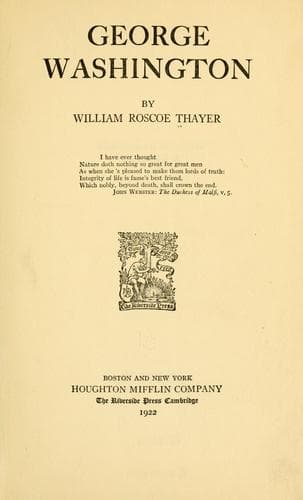
Presidents -- United States -- Biography; Washington, George, 1732-1799
Thus wrote the Silent Member six years before the outbreak of
hostilities, and he did not then display any doubt either of his
patriotism, or of the course which every patriot must take. To his
intimates he spoke with point-blank candor. Years later, George Mason
wrote to him:
I never forgot your declaration, when I had last the pleasure of
being at your house in 1768, that you were ready to take your
musket upon your shoulder whenever your country called upon you.
Some writers point out that Washington excelled rather as a critic of
concrete plans than of constitutional and legal aspects. Perhaps this
is true. Assuredly he had no formal legal training. There were many
other men in Massachusetts, in Virginia, and in some of the other
Colonies, who could and did analyze minutely the Colonists' protest
against taxation without representation, and the British rebuttal
thereof; but Washington's strength lay in his primal wisdom, the
wisdom which is based not on conventions, even though they be laws and
constitutions, but on a knowledge of the ways in which men will react
toward each other in their primitive, natural relations. In this
respect he was one of the wisest among the statesmen.
He does not seem to have joined in such clandestine methods as those
of the Committees of Correspondence, which Samuel Adams and some of
the most radical patriots in the Bay State had organized, but he said
in the Virginia Convention, in 1774: "I will raise one thousand men,
subsist them at my own expense and march myself at their head for the
relief of Boston."[1] The ardor of Washington's offer matched the
increasing anger of the Colonists. Lord North, abetted by the British
Parliament, had continued to exasperate them by passing new bills
which could have produced under the best circumstances only a
comparatively small revenue. One of these imposed a tax on tea. The
Colonists not only refused to buy it, but to have it landed. In Boston
a large crowd gathered and listened to much fiery speech-making.
Suddenly, a body of fifty men disguised as Mohawk Indians rushed
down to the wharves, rowed out to the three vessels in which a large
consignment of tea had been sent across the ocean, hoisted it out of
the holds to the decks and scattered the contents of three hundred and
forty chests in Boston Harbor.
[Footnote 1: _John Adams's Diary_, August 31, 1774, quoting Lynch.]
Public-domain text, read in full here on John Shaqi.
Reviews
Reviews
No reviews yet
Be the first to share your thoughts on this work.
Join the Discussion
Join the discussion
Sign in to leave a comment or review.
Sign InorCreate an account