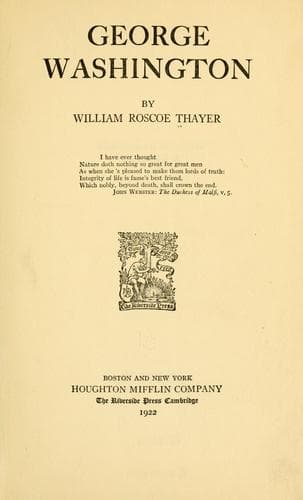
Presidents -- United States -- Biography; Washington, George, 1732-1799
Howe was recalled to England and General Sir Henry Clinton succeeded
him in the command of the British forces. He was one of those
well-upholstered carpet knights who flourished in the British army at
that time, and was even less energetic than Howe. We must remember,
however, that the English officers who came over to fight in America
had had their earlier training in Europe, where conditions were quite
different from those here. Especially was this true of the terrain.
Occasionally a born fighter like Wolfe did his work in a day, but this
was different from spending weeks and months in battleless campaigns.
The Philadelphians arranged a farewell celebration for General Howe
which they called the _Meschianza_, an elaborate pageant, said to be
the most beautiful ever seen in America, after which General Howe and
General Clinton had orders to take their army back to New York. As
much as could be shipped on boats went that way, but the loads that
had to be carried in wagons formed a cavalcade twelve miles long, and
with the attending regiment advanced barely more than two and a half
miles a day. Washington, whose troops entered Philadelphia as soon as
the British marched out, hung on the retreating column and at Monmouth
engaged in a pitched battle, which was on the point of being a
decisive victory for the Americans when, through the blunder
of General Lee, it collapsed. The blunder seemed too obviously
intentional, but Washington appeared in the midst of the mêlée and
urged on the men to retrieve their defeat. This was the battle of
which one of the soldiers said afterwards, "At Monmouth the General
swore like an angel from Heaven." He prevented disaster, but that
could not reconcile him to the loss of the victory which had been
almost within his grasp. Those who witnessed it never forgot
Washington's rage when he met Lee and asked him what he meant and then
ordered him to the rear. Washington prepared to renew the battle on
the following day, but during the night Clinton withdrew his army, and
by daylight was far on his way to the seacoast.
Washington followed up the coast and took up his quarters at White
Plains.
CHAPTER VI
AID FROM FRANCE; TRAITORS
Public-domain text, read in full here on John Shaqi.
Reviews
Reviews
No reviews yet
Be the first to share your thoughts on this work.
Join the Discussion
Join the discussion
Sign in to leave a comment or review.
Sign InorCreate an account