German Atrocities: Their Nature and PhilosophyHillis, Newell Dwight
History
German Atrocities: Their Nature and Philosophy
Hillis, Newell Dwight
Pangermanism; World War, 1914-1918; World War, 1914-1918 -- Atrocities
More terrible still the scheme invented by the Kaiser and the War
Staff for breaking down the conscience of the German soldier. The
simple peasants of Bavaria, the artisans of Saxony, until a generation
ago, were reared in the morals of Martin Luther. By common consent
Luther is one of the great men of modern times. At a critical moment
in history he stood forth affirming Paul's statement that every man
must give an account of himself unto God. Since Pope Julius could not
give his account unto God, Martin Luther claimed religious liberty
as to creed and conduct for himself. Since no kaiser could give his
account unto God, Martin Luther claimed the right of self-government,
through political democracy. Since no philosopher could give his
account, Luther demanded liberty of thought and speech. Carrying out
this principle, when three hundred years had passed, the free nations
stood forth clothed with political democracy, educational democracy,
religious democracy, industrial democracy. Just as we trace some
river back to a spring on the mountainside, so we trace these great
institutions of the Reformation back to Martin Luther, who received his
ideas from Paul and John, from Huss and Savonarola, reinforced by John
Calvin and Erasmus.
THE SOLDIER'S TOKEN
But Luther's ethics were the ethics of Moses. For several generations
the German peasants had been taught that it was criminal to kill,
steal, burn, rape and pillage. They knew by heart the words of Jesus,
"Woe unto him who offends against one of my little ones; it were better
for him that a millstone were hanged about his neck, and that he were
drowned in the depths of the sea." Plainly the Ten Commandments stood
squarely in the pathway of the Kaiser's ambition. Unless his ambitions
for world rule were to be defeated, some scheme had to be invented
to free the German soldier from conscience, and break the fetters of
divine law.
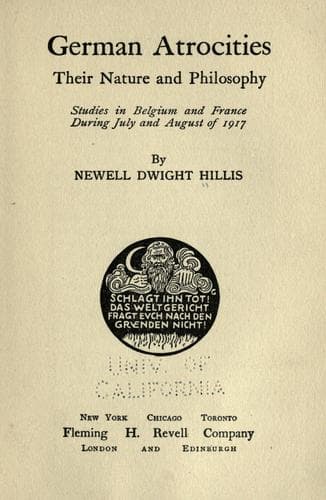
Therefore the soldier's token was invented. It comes under Jesus'
special condemnation, in that not only the Kaiser and the War Staff
pursued crime, but "taught men so." These tokens are made of stiff
cardboard or of aluminum. At the top is a portrait of Deity as the
Kaiser conceives him to be; in one hand the Kaiser's God holds a
sickle, for the death-harvest. Beneath, the Kaiser and his War Staff
wrote these words, "Strike him dead; the Day of Judgment will not ask
you for reasons."
Public-domain text, read in full here on John Shaqi.
Reviews
Reviews
No reviews yet
Be the first to share your thoughts on this work.
Join the Discussion
Join the discussion
Sign in to leave a comment or review.
Sign InorCreate an account