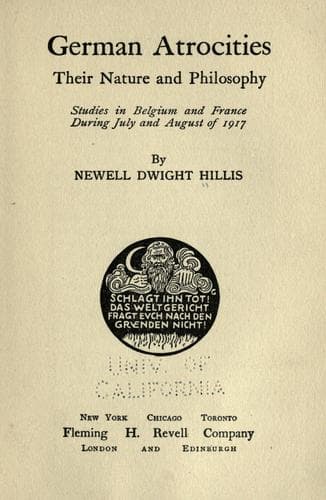
German Atrocities: Their Nature and Philosophy — John Shaqi
German Atrocities: Their Nature and PhilosophyHillis, Newell Dwight
History
German Atrocities: Their Nature and Philosophy
Hillis, Newell Dwight
Pangermanism; World War, 1914-1918; World War, 1914-1918 -- Atrocities
Plainly the soldier's token and the Kaiser's scheme succeeded. Having
stated that he had murdered men, young Eitel Anders sleeps well at
night, and the "next morning in happy mood and high spirits" wakened
to plan fresh crimes. Macbeth had no German soldier's token to help
him sleep at night. Conscience became the whisper of God in his soul.
Sleep forsook his eyes, and slumber his eyelids. Shakespeare's murderer
did not dare trust himself out under the stars that blazed with anger,
but Eitel Anders' sleep was not disturbed by the blood upon his hands,
because he really believed the Kaiser would be able to stand between
him and the Great Day of Judgment.
After General Clauss shot fifteen aged men in the streets of
Gerbéviller, too, that officer rode away with a light heart, quite
free from the remorse that unseated the reason of Macbeth. Plainly
the Kaiser's scheme succeeded. It destroyed conscience in many German
officers and soldiers alike. To-day, the men of Germany without moral
sense or any remorse following their crimes are like a sky that holds
an empty socket where once the summer-making sun had shined. They are
like human bodies out of which the intellect has passed, leaving only
gibbering idiots. The German "Laws of War on Land," their Handbook of
Military Tactics, has organized crime into a science, and killed in men
the spiritual optic nerve. Germany to-day is an intellectual machine,
and her officers and her soldiers at last can commit crimes without
remorse, which proves that they are becoming moral idiots.
GERBÉVILLER THE MARTYRED[1]
In August of 1914, when the German army was broken and compelled to
retreat before the French, they passed through many French towns and
villages in which they found no soldiers and no weapons, and where no
battle, no skirmish and no shot took place. During last July and August
we went slowly from one of these ruined towns to another, talking
with the broken-hearted women and children, comparing the photographs
taken immediately after the German retreat and almost before the
mutilated bodies were cold. Slowly we sifted the evidence. On the
ground we compared the full official records made at the time, with the
statements of wretched survivors who live in cellars, where once stood
the beautiful homes, the orchards and vineyards, but where now all is
desolation and anguish.
Public-domain text, read in full here on John Shaqi.
Reviews
Reviews
No reviews yet
Be the first to share your thoughts on this work.
Join the Discussion
Join the discussion
Sign in to leave a comment or review.
Sign InorCreate an account